
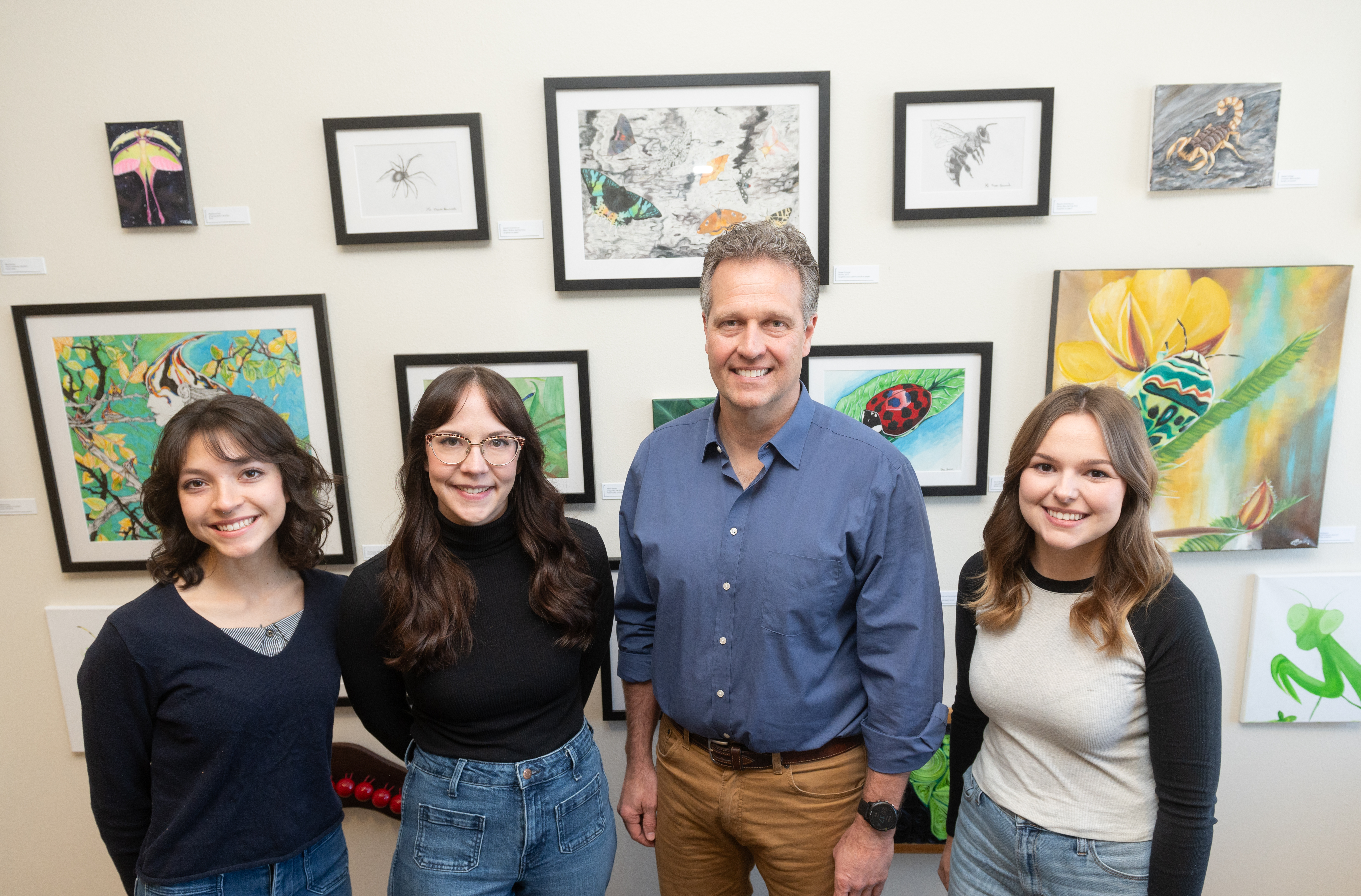
Titled “Insects in Art,” the exhibit is a kaleidoscope of more than two dozen paintings, drawings and mixed-media pieces created by New Mexico State University students over the past eight years.
Source: NMSU Newsroom
By Tatiana Favela
Photos: Courtesy
A version of this story appears in the fall 2025 issue of ACES Magazine. For more stories, visit https://nmsu.news/aces-magazine-2025.
Whether they have colorful wings, multiple legs or eyes, or even stingers on their behinds, insects serve an essential purpose – and their beauty has inspired a new permanent wall exhibit in NMSU’s Skeen Hall.
Titled “Insects in Art,” the exhibit is a kaleidoscope of more than two dozen paintings, drawings and mixed-media pieces created by New Mexico State University students over the past eight years. It came together through a collaboration between Scott Bundy and the University Art Museum.
Bundy, a professor in the Department of Entomology, Plant Pathology and Weed Science, teaches an undergraduate course designed to expose students to the world of insects and other arthropods living in various environments. The class, which is open to students from all academic backgrounds, includes a creative assignment where students draw inspiration from insects to craft a visual art piece.


“I’ve been doing it for several years, and every year, I get some cool art that people come up with,” Bundy said. “I’ve been wanting to display it for years, to have a place to say, ‘Look how amazing insects are,’ and to show the things people have done in my class.”
Courtney Uldrich, collections curator at the University Art Museum, led the team tasked with bringing the exhibit to life along a second-floor wall in the northeast corner of Skeen Hall. Uldrich’s team also included Maya Jo Yurcic, curatorial intern, and Olivia Juedeman, collections assistant.

“I was given the opportunity by Courtney to take the lead on this project from start to finish,” Yurcic said. “This included creating an inventory list for all the artworks, designing the artwork layout on the wall, creating object labels and a title design on vinyl, and installing the works with the help of my colleague, Olivia Juedeman.”
Juedeman added, “Together, we installed around 25 pieces using security hardware. While installation can be tedious, Maya Jo’s meticulous pre-planning of the layout made the process go by fast.”
Some of the artwork dates to 2017 and includes sketches, paintings and 3D pieces that capture the diversity and detail of insects.
“I’ve always looked forward to new things students come up with, and some of them have really impressive artistic abilities,” Bundy said. “Students come from all over campus – some are art students, and others are not, but they just have an inspiration to create something. It’s amazing to see the differences in talent and how they interpret their inspiration from insects.”
Bundy hopes the exhibit will lead to future collaborations with the University Art Museum.
“We all have our different expertise, and mine is insects, and I love to show how photogenic and amazing they are,” he said. “I’m excited to continue doing more of those types of things.”
He added that the exhibit will grow and change over time, with the addition of new student artwork.
“I am a staunch believer that everyone is an artist, and I am so glad to see that Dr. Bundy also sees that in his students and was able to display their work in such a lively and accessible way,” Yurcic said. “Collaborations like this, between the University Art Museum and the larger NMSU campus, are so special, and we invite them to happen as often as possible.”
The Secrets of Illustrating Bug Beauties in the 17th Century
November 20, 2025
Posted by: Neely Tucker
This is a guest post by Cindy Connelly Ryan, a preservation science specialist in the Preservation Research and Testing Division, and Jessica Fries-Gaither, an Albert Einstein distinguished educator fellow at the Library. It also appears in the September-October issue of the Library of Congress Magazine.

Maria Sibylla Merian sketched this image for Metamorphosis Insectorum Surinamensium in 1705. Rare Book and Special Collections Division.
Would you raise insects in your kitchen? Travel thousands of miles from home to study them?
Maria Sibylla Merian, a 17th-century natural scientist, artist and engraver, did just that and broke new ground in science and art.
Born in Germany in 1647 and later a resident of the Netherlands, Merian raised the larvae of caterpillars, butterflies and moths, determined their preferred food plants and observed adults emerging from their pupal chrysalides and cocoons. Her detailed notes and sketches became the basis for several groundbreaking books on caterpillars. She pioneered scientific illustration techniques by using counterproof printing to create softer images that more closely resembled her original drawings. She published De Europischen Insecten, and the Library preserves a copy of that book, now more than 300 years old.
In 1699, the intrepid Merian and her youngest daughter journeyed to the Dutch colony of Suriname in South America to study and paint insects. Back home, she published a book in 1705 — Metamorphosis Insectorum Surinamensium (Metamorphosis of Surinamese Insects) — that featured vibrant color illustrations of exotic species.
Recent analysis by scientists in the Library’s Preservation Research and Testing Division revealed details about how the book’s colors were created. X-ray fluorescence provided elemental “fingerprints” of materials, and reflectance spectroscopy captured chemical bonds’ visible and near-infrared absorption features. Multiband microscopy revealed details of the paints’ textures, layering and application techniques.

Merian’s artwork, here of spiders, gained her lasting fame. Rare Book and Special Collections Division.
The red cherries are rendered with the poisonous pigment vermilion applied in matte and glossy layers to model depth. The caterpillar hungrily advancing up the branch is rendered in at least eight shades of yellow, gold, orange and red, all made from mixtures of just two pigments.
The colorants were created with a combina tion of European and imported raw materials. Butterflies get their blue colors from thin layers of azurite, a mineral mined in Hungary and Germany. Translucent pink and burgundy tones come from brazilwood, a South American tree first used by European artists in the early 1600s.
In this way, modern science sheds new light on centuries-old science and art.
You must be logged in to post a comment.