
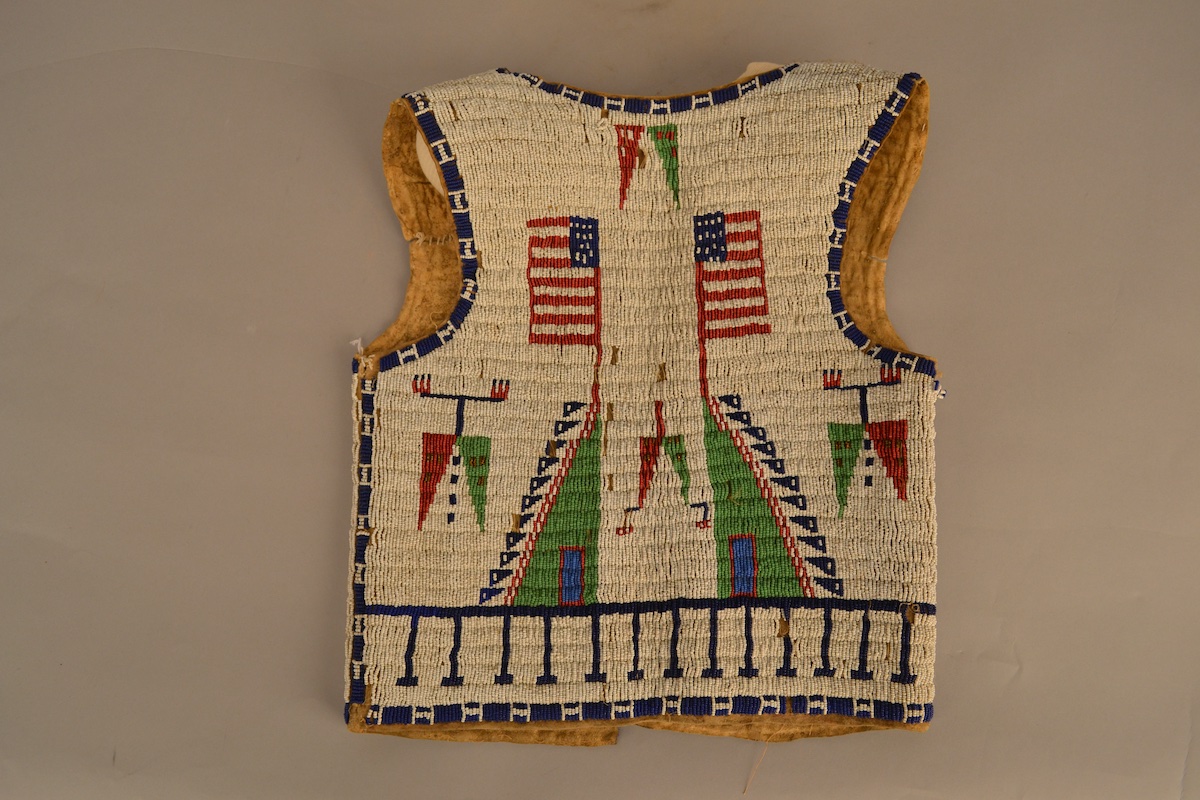
The complex relationship between First Americans and the United States flag has been shaped by the experiences of multiple generations over hundreds of years.
Source: N.M. Department of Cultural Affairs
Photos: Courtesy
Cover Photo Caption: Vest, Lakota, 1890-1923, Glass beads and faceted metallic beads on cowhide (Gift of Claiborne O’Connor In Memory of Arthur B. Chivvis). The Code of Indian Offenses was enacted by the United States government in 1883 to encourage tribes to assimilate by restricting their religious and cultural activities. One way tribal members continued to participate in cultural ceremonies and dances was under the guise of celebrating Independence Day on July 4. Traditional clothing and other objects made for these celebrations were heavily decorated with American flags.
SANTA FE, N.M. — In recognition of the nation’s 250th anniversary, the Museum of Indian Arts and Culture (MIAC) presents Stars, Stripes, and First Americans, opening May 17, 2026.
This exhibition examines the complex and evolving relationship between Indigenous peoples and the American flag, highlighting the diverse ways Native artists have incorporated its imagery into their work. Featuring beadwork alongside contemporary painting, weavings, and jewelry, the exhibition explores the flag as a decorative motif, a strategy for survival, a warrior’s mark of honor, and a symbol of resistance.


Moccasins, Taos Pueblo, before 1959, “Glass beads, cotton thread, and sinew on buckskin” (Museum of Indian Arts and Culture Purchase). In Native art, the flag is often represented by its elements rather than a faithful depiction of every star and stripe.
“The American flag carries many meanings, and for Native communities, those meanings are often layered and deeply personal,” said Elisa Phelps, MIAC Head of Curatorial Affairs. “In these works, the flag is not just a symbol of the United States—it becomes a site of memory, resilience, and sovereignty. Artists are reclaiming and reshaping it to tell their own stories.”
Spanning generations, Stars, Stripes, and First Americans reflects the layered histories that shape Indigenous engagement with the United States. While the flag can evoke the painful legacy of colonization and oppression, it also represents pride in military service and the enduring resilience of Native communities.

From realistic renderings to abstract interpretations, the exhibition brings together traditional art forms and contemporary practices. Each work contributes to an ongoing dialogue about identity, sovereignty, and cultural revitalization, demonstrating how artists continue to reinterpret the flag in ways that are both deeply personal and politically resonant.
The stars and stripes of the American flag are found everywhere today, including on clothing, billboards, and bumper stickers. This practice is not new; the United States officially adopted the design of the flag in 1777, and it has been used for decorative purposes ever since.
What may be surprising is that in the late nineteenth century some Native American artists began to incorporate the flag into their work. Given the United States government’s treatment of Native peoples, the flag may seem an unusual design choice. However, its use carried meaning as a survival strategy, a warrior’s mark of honor, a symbol of protection, or an emblem of resistance.
The complex relationship between First Americans and the United States flag has been shaped by the experiences of multiple generations over hundreds of years. While use of the flag in Native art is a reminder of the painful history of colonization, displacement, and oppression, it also represents the long tradition of pride in military service.

Pictorial Weaving, September 11, 2001, Pauline Thomas (Diné) 2001-2002, Tapestry weave with wool yarn. (Museum Purchase, Drs. Norman & Gilda Greenberg Purchase Fund). Commemorating the loss of life and destruction of the World Trade Center in 2001, this weaving was purchased from the artist at the 2002 Totah Festival in Farmington, N.M.
From the realistic to the abstract, images of the flag can be found in traditional art forms and contemporary artistic expressions. Each generation interprets the flag to fit its own narrative as part of an ongoing dialogue about identity, sovereignty, and cultural revitalization.
On view in the Lloyd Kiva New Gallery, the exhibition included work by Pauline Thomas (Diné), Joanne Begaye (Diné), Teri Greeves (Kiowa), Mary Coriz (Santo Domingo Pueblo), and Richard Kee Yazzie (Diné).
About the Museum of Indian Arts & Culture
The Museum of Indian Arts & Culture is a division of the Department of Cultural Affairs, under the leadership of the Board of Regents for the Museum of New Mexico. Programs and exhibits are generously supported by the Museum of New Mexico Foundation and our donors. The mission of the Museum of Indian Arts & Culture/Laboratory of Anthropology is to serve as a center of stewardship, knowledge, and understanding of the artistic, cultural, and intellectual achievements of the diverse peoples of the Native Southwest.
ACKNOWLEDGEMENTS
The Museum of Indian Arts and Culture wishes to extend its sincere thanks to all of those who made this exhibition possible, including:
- Museum of New Mexico Foundation
- National Museum of the American Indian
- The Museum Resources Division Exhibit and Conservation Services
You must be logged in to post a comment.