
Intellectual property rights protect creations of the mind, including copyrightable creative works, inventions protected by patents, brands protected by trademarks, and commercially valuable information protected under trade secret law.
Source: Library of Congress
The following blog is authored by Ashley Tucker, with legal research by Jessica Chinnadurai and Laura Kaiser.
Images: Courtesy
Over the last several years on January 1, the Library of Congress has witnessed a new class of creative works entering the public domain in the United States. In 2026, a variety of works published in 1930, ranging from motion pictures to music to books, joined others in the public domain.
What is copyright and how is it different from other types of intellectual property?
Copyright is a type of intellectual property (IP) that protects original works of authorship as soon as an author fixes the work in a tangible form of expression. Intellectual property rights protect creations of the mind, including copyrightable creative works, inventions protected by patents, brands protected by trademarks, and commercially valuable information protected under trade secret law. Unlike some other areas of IP, which require government action to secure protection, copyright protection is automatic—although registration confers additional benefits.
Copyright law arises from Article I, section 8 of the Constitution, which grants Congress the power, “To promote the Progress of Science and useful Arts, by securing for limited Times to Authors and Inventors the exclusive Right to their respective Writings and Discoveries.” The Copyright Act describes the exclusive rights of copyright owners : the right to use and give permission for others to use their work in many ways—making copies of and distributing the work, creating derivative works, and publicly performing or displaying the work. Under the Constitution, these rights last for “limited times.” The first federal copyright law, dating back to 1790, protected registered works for fourteen years with a fourteen-year renewal option. The law has changed over time, and today, the term of copyright protection lasts for the author’s life plus an additional seventy years.
When copyright protection ends, a work enters the public domain, and the exclusive rights granted by copyright no longer exist. This means that without a need to seek permission, a work may be reproduced, may be performed or displayed publicly, and may also be used in the creation of new works, such as adaptations and translations. However, even when copyright protection ends and a work is in the public domain, it is important to note that it may still be subject to other protections.
Below are just a few of the historical and cultural works that entered the public domain in 2026.
LITERARY WORKS
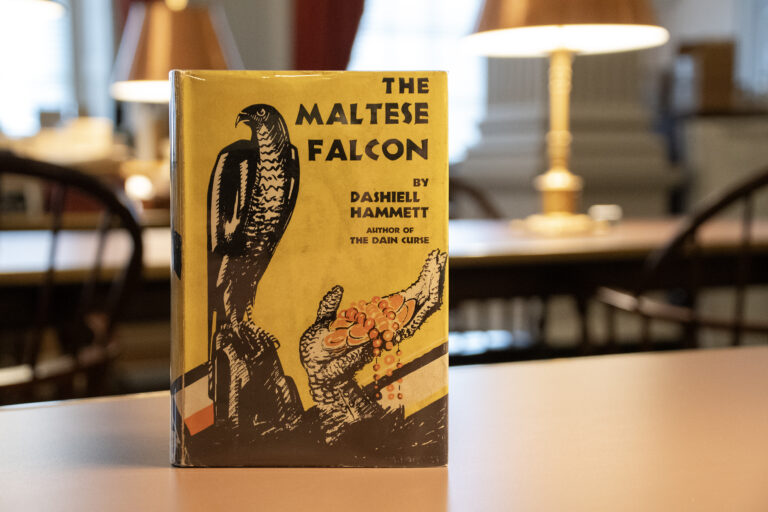
The Maltese Falcon

Dashiell Hammett was an American writer and former detective whose real-world investigative experiences shaped his writings. In 1930, he published the book The Maltese Falcon: a crime novel that follows private detective Sam Spade as he navigates a dangerous search for a legendary jewel-encrusted statuette.
Hammett and his publisher, Alfred A. Knopf, Inc., signed a contract giving Warner Bros. the exclusive right to use his novel in film, television, and radio, which resulted in the 1941 film of the same name. Hammett and Knopf later gave CBS the exclusive right to use the novel’s Sam Spade character. Warner Brothers objected and sued for copyright infringement.
The appellate court reviewing the case briefly considered a character’s role in a story and to what extent copyright law intends for characters to be protected. A film prop of the Maltese Falcon is featured in the Find Yourself in Copyright exhibit in the Library of Congress Madison building.
As I Lay Dying
As I Lay Dying is a modernist novel by William Faulkner that follows the Burden family’s difficult journey to bury their matriarch. Faulkner, a Mississippi-born writer, is known for the creative risks he took. He often told stories from many points of view, used stream of consciousness writing, and based much of his writing on a detailed, fictional version of his home region.
His deep ties to the South and his interest in how people think and behave shaped the way he wrote this work. The story is told through a series of deeply personal narrators who explore themes of grief, identity, and the harsh realities of rural Southern life. After it was published, the novel became one of his most famous works. The 1949 Nobel Prize in Literature was awarded to Faulkner “for his powerful and artistically unique contribution to the modern American novel.”
Books in The Nancy Drew Series: The Secret of the Old Clock, The Hidden Staircase, The Bungalow Mystery, The Mystery at Lilac Inn

Mildred Wirt Benson, under the pseudonym Carolyn Keene, authored twenty-three of the first thirty books in the Nancy Drew series: a long-running collection of mystery novels for young readers. These early books introduced the core aspects of Nancy Drew’s character: a clever, courageous girl determined to help others and unravel mysteries.
Benson modeled Nancy Drew after her own bold spirit and independent mindset. Benson was an adventurous Iowa native and one of the first women to earn a master’s degree in journalism from the University of Iowa. Only late in life did she receive public recognition for her role in shaping one of America’s most well-known fictional heroines.
Titles entering the public domain:
- The Secret of the Old Clock: The very first Nancy Drew mystery, which introduced Nancy as a daring teenager actively pursuing justice.
- The Hidden Staircase: The second book in the series, which deepened the series’ signature blend of suspense and female empowerment.
- The Bungalow Mystery: The third book in the series, which expanded Nancy’s world with more complex clues.
- The Mystery at Lilac Inn: The fourth book in the series, which sharpened the tone of danger and investigation.
MOTION PICTURES
Animal Crackers

The comedy film, which stars Groucho, Harpo, Chico, and Zeppo Marx (the stage names for the siblings collectively known as the Marx Brothers), centers on a lavish party at a wealthy Long Island estate. At the party, a valuable painting goes missing, setting off a series of comedic events and slapstick antics as the Marx Brothers try to find it.
Animal Crackers marked the Marx Brothers’ second screen appearance and the last film they shot at Paramount’s Astoria Studios in New York before moving their work to Hollywood. The film was adapted directly from a 1928 Broadway musical play. The play was written by George S. Kaufman, Bert Kalmar, Morrie Ryskind, and Harry Ruby and was registered with the U.S. Copyright Office as an unpublished work in 1929 (also now in the public domain).
Soup to Nuts
Soup to Nuts, written by famed cartoonist and inventor Rube Goldberg, follows a struggling costume shop whose eccentric owner spends more time creating absurd inventions than running the business. The film marks the screen debut of Moe Howard, Larry Fine, and Shemp Howard, who eventually evolve into the Three Stooges, one of America’s most famous comedy teams. Their appearances showcase early versions of the rapid-fire, physical comedy, and ensemble timing that would later define their career.
MUSICAL WORKS
I Got Rhythm
The song was written by George Gershwin for the 1930 musical Girl Crazy by J. McGowan and G. Bolton. With its simple thirty-two-bar AABA structure and distinctive chord progression, the song’s form and harmony have been reused and re-imagined in hundreds of jazz tunes, including by famous artists such as Ella Fitzgerald and Louis Armstrong. Even its composer revisited the piece: Gershwinlater expanded the song into a symphonic work titled Variations on I Got Rhythm.
You must be logged in to post a comment.