
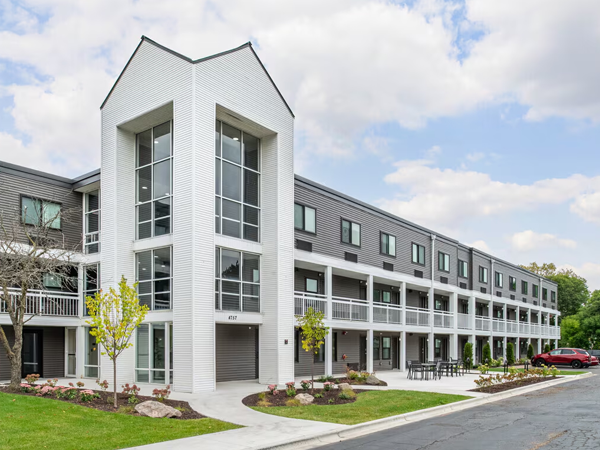
In Madison, Wisconsin, Wiseman Capital Group converted a motel to 129 studio units of naturally occurring affordable housing without the need for public subsidies.
Source: Housing and Urban Development
Cover Photo Credit: Wiseman Capital Group
For every unit of subsidized affordable housing in the United States, there are three units of unsubsidized, market-rate affordable housing, often termed naturally occurring affordable housing. In Madison, Wisconsin, the Wiseman Capital Group recently completed, without public subsidy, the transformation of a former Super 8 motel into an apartment development called Sandburg Studios. The 3-story structure consists of 129 studio apartments that range in size from 277 to 344 square feet, offering furnished or unfurnished short- or long-term leases to renters that include students, visiting nurses, and business travelers. While the rents at Sandburg Studios are determined by Madison’s rental market, those rents are significantly more affordable than Madison’s average rent, filling a market niche and demonstrating how a creative developer using private capital can create new affordable housing opportunities.
Receive the latest stories in your inbox every day — FREE!
Transforming the Motel into Studio Apartments
As the Wiseman Group was looking for its next project, the Super 8 presented both a problem to be solved and a prime opportunity for a motel-to-housing conversion. The problems were well known. In its final years operating as a motel, the old Super 8 had become a nuisance for the neighborhood, with police calls increasing by 133 percent between 2019 and 2023. Yet the location, according to Cody Wiseman, founder and chief executive officer of the Wiseman Group, had great potential for future housing. Whereas many motels or hotels are in commercial areas, the Super 8 was adjacent to a residential area, providing a neighborhood context that could make the building’s conversion to apartments more successful by increasing its appeal to potential tenants. Sandburg Studios is in a “commercial corridor-transitional” zoning district that permits both residential and commercial uses, and the city agreed that the project would be compatible with both the residential and commercial areas abutting the site. Similarly, neighborhood residents welcomed the transformation of the nuisance property, reports Wiseman. By being adjacent to a residential neighborhood, Sandburg Studios feels more like a typical apartment building rather than a converted motel.
Market research, which demonstrated the dearth of affordable studio apartments relative to demand, also backed up the plan for the site and confirmed that this was the most cost-effective conversion strategy, Wiseman shared. By being near the Madison Area Technical College (which has no on-campus housing), the local airport, and the recently opened University of Wisconsin Medical Center, the development is well-positioned to serve students, frequent business travelers, and traveling nurses. To cater to its more transient residents, some units at Sandburg Studios are available furnished and for shorter-term leases.
Project Details
To convert the motel into studio apartments, Wiseman gutted and renovated the building. The layout of the building retains the basic floorplan of the motel, with the addition of a kitchenette complete with an oven, microwave, and refrigerator in each unit. Converting to studios, Wiseman found, would also be better able to support the project financially compared to conversion into larger units. Wiseman described Sandburg Studios as an “affordable luxury” product and, as part of that approach, Sandburg Studios includes a fitness center, outdoor dog run, grilling stations, co-working space, and a refurbished pool.

Sandburg Studios is an “affordable luxury” product catering to students, traveling nurses, and people visiting Madison regularly for business. Photo credit: Wiseman Capital Group
Design decisions were aimed at creating a more residential feel, including the use of sliding barn doors for each unit’s bathroom and a backsplash in each kitchen. Other interior improvements include new drywall, doors, plumbing, and wiring. On the exterior, Wiseman modified the roofline to create a cleaner, more modern look, and replaced the roofing, siding, windows, and doors. Wiseman enhanced the building landscape, including using a year-round landscaping strategy to help mitigate noise coming from the nearby highway. Overall, the new exterior design is intended to better complement the surrounding area. Using thoughtful design and quality materials, Wiseman says, helped to drive the high demand that Sandburg Studios has seen since welcoming its first tenant in June 2025 and leasing up ahead of projections.
Thanks to the project having been privately funded, Sandburg Studios can offer its apartments to anyone for whom a small studio fits their need; this helps to reduce market competition for other, larger units in the Madison rental market that might be a better fit for others, says Wiseman. As of October 2025, average rent in Madison was $1,750 per month for all rental units and the average rent for a studio was $1,169. At opening, Sandburg Studios units rented between $975 and $1,125. Overall, the project demonstrates the role that market-driven, unsubsidized development can play in growing a community’s supply of naturally occurring affordable housing.
You must be logged in to post a comment.