
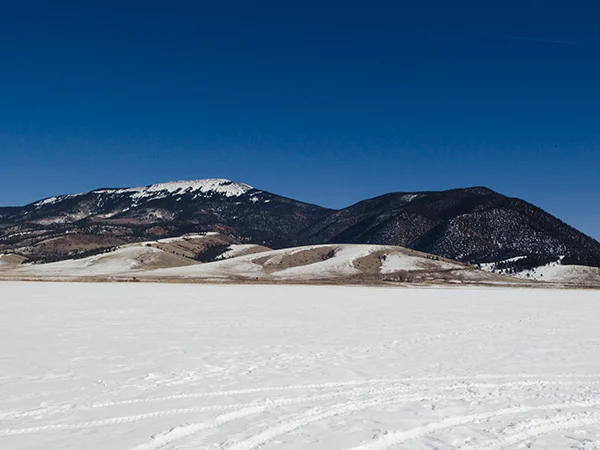
The ice surface at Eagle Nest Lake (Northeast New Mexico) remains closed to all activities due to deteriorating ice conditions.
Source: New Mexico Wildlife
Images: Courtesy

Southwest New Mexico Fishing Report
- Bear Canyon Lake: Fishing conditions have been adversely affected in the aftermath of the Trout Fire.
- Bill Evans Lake: The most recent report was received Feb. 12. At that time, fishing for trout was good when using Kastmasters from a boat.
- Elephant Butte Lake: The most recent report was received Jan. 29. At that time, fishing for white bass was very good when using Rat-L-Traps. The South Monticello boat ramp is currently closed, and access to Rattlesnake Island is restricted due to low water levels. The closures will be lifted when water levels rise and conditions allow.
- Escondida Lake: Fishing for trout was slow to fair when using Garlic PowerBait and corn.
- Gila River: Streamflow near Gila on Wednesday morning was 115 cfs.
- Gila Waters: Streamflow near Gila Hot Springs on Wednesday morning was 71.9 cfs.
- Rio Grande: The most recent report was received Jan. 29. At that time, fishing for trout was fair to good when using worms. Fishing for walleye was good when using minnows. Streamflow below Elephant Butte Dam on Wednesday morning was 0.06 cfs.
- Young Pond: The most recent report was received Feb. 12. At that time, fishing for trout was fair to good when using inline spinners.
New Mexico Wildlife received no reports for the following waterbodies over the past three weeks: Caballo Lake, Glenwood Pond, Lake Roberts, Percha Dam, Quemado Lake, Rancho Grande Ponds, Snow Lake and Trees Lake.
How do you fish when it’s windy outside?
By Darren Vaughan
If you’re going to fish in New Mexico, chances are you’re going to have to deal with the wind at some point. After all, the Global Wind Atlas ranks the Land of Enchantment as the 15th-windiest state in the U.S. (13th in the lower 48), just behind Texas and just ahead of New York.
For some, a stiff breeze might be enough to spoil an otherwise good day of angling. However, with a few tweaks, you can use the wind to your advantage.
First, make sure to cast downwind. Casting with the wind at your back can make for longer, more accurate casts, while casting into the wind can blow your hook right back toward you. Second, you should use a heavier lure. Light lures can get caught in the wind and potentially go somewhere you don’t want them to go — that tree just downstream might become an undesired catch of the day. A heavier lure can cut through the wind and go where you want it to. You’ll also want to pick something a bit flashier, as the water may become murky as the wind churns it up.
Pay attention to which direction the wind is blowing. If it is blowing toward one of the banks, it is likely pushing your fish of choice — and their food of choice — that direction as well. If there’s a bunch of food piled up against that bank, then there’s likely more fish in search of a meal over there, too.
Of course, there are times when the wind is too strong. I’ve heard people say that the sweet spot is below 10 mph, while 10-15 mph is OK, and anything over 15 mph is too windy. However, everyone’s got their opinion, and maybe for some of you, 20 mph works well, or perhaps any wind at all makes your luck disappear.
But wind doesn’t have to spoil your fishing day. In fact, it can actually improve it.
Let New Mexico Wildlife know how your fishing trip goes! Share your tips and tricks with your fellow anglers by filling out the iFish form,and let’s help the next generation of anglers find success.
You must be logged in to post a comment.