
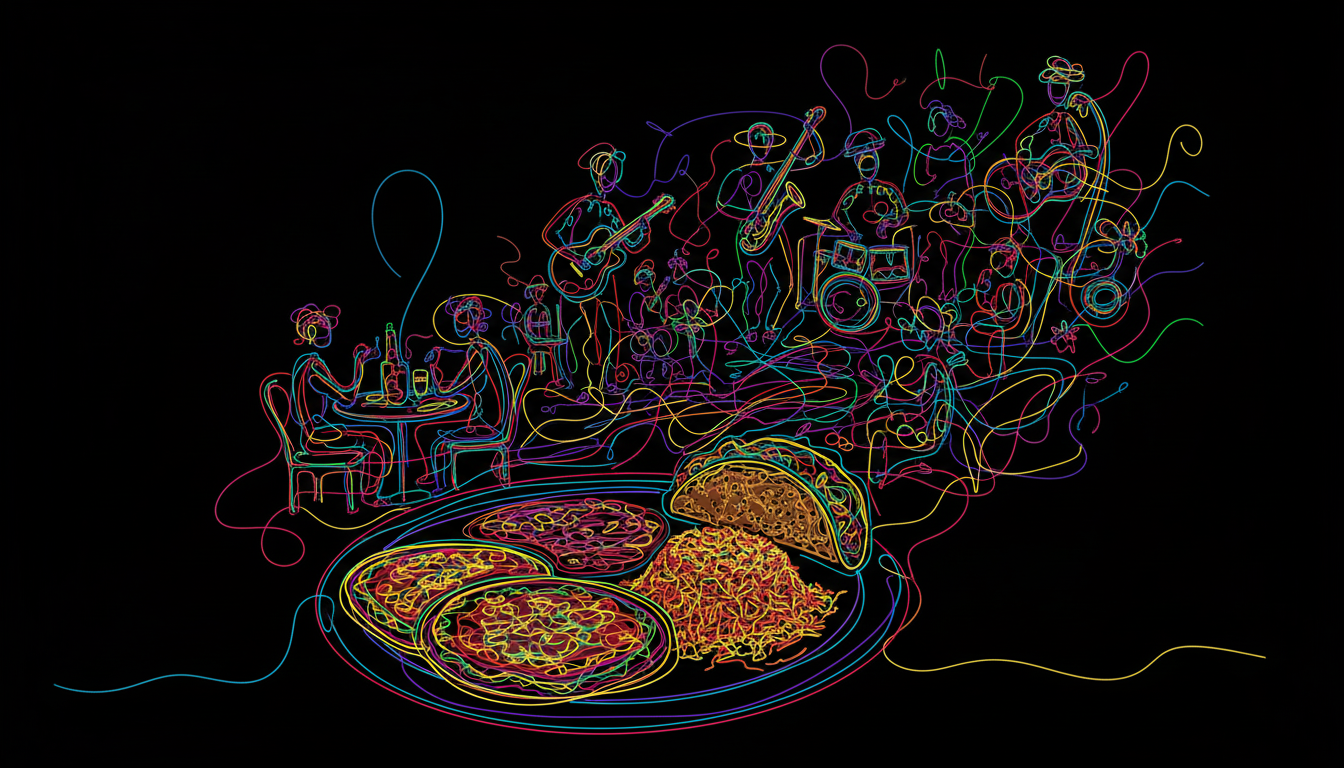
It is one of the most economical great meals in the world.
By Levi Gwaltney
In the summer of 1991, a bona fide güero took a job in an onion shed in Hatch, New Mexico. For those who know, agricultural work in southern New Mexico doesn’t end at the edge of the field. It continues wherever the harvest is sorted, graded, and prepared for market. The onion sheds of Hatch, Las Cruces and Deming are cavernous places—steel roofs stretched over long conveyor belts, forklifts humming in the loading bays, and the earthy smell of dust and produce lingering in the hot shade.
The work was seasonal and relentless. When the onion harvest begins, trucks line up before sunrise and continue rolling in long after dark. Workers stand shoulder to shoulder along the grader belts moving onions from one bin to another while the machinery rattles and the day stretches out in the heat.
Lunch is rarely part of the plan.

One afternoon in mid-July, the grader belt broke. The machinery fell silent and the entire shed paused for the first time that day. With trucks waiting outside and equipment cooling in the still air, the young man sat on the concrete floor and leaned against a pallet stacked with forty-pound onion sacks.
He hadn’t packed lunch.
During harvest season, eating is often a luxury.
A voice broke the quiet. “Lonche?”
It was Don Tani, one of the older workers on the crew, a man who had barely spoken during the first weeks of the harvest.
The invitation was simple. Lunch.
A few minutes later the two men climbed into Don Tani’s well-used Ford and drove a short distance outside Hatch to a cluster of trailers serving as housing for migrant workers. Inside one of those trailers, Don Tani’s wife pulled two plates from a cupboard and began assembling lunch without a word of greeting.
Three red enchiladas.
A spoonful of whole pinto beans.
A folded towel holding warm tortillas placed in the center of the table.
Following Don Tani’s lead, the young man tore off a piece of tortilla and used it to guide the beans onto his fork, catching a little red chile along the way. First the beans. Then the tortilla. Then the enchiladas.
The meal was familiar, but it was different from the enchiladas he had grown up eating in the Mesilla Valley.
The tortillas were thicker and softer. The red chile sauce was brighter and looser than the darker gravies he knew. And the cheese—a salty white crumble—was nothing like the melted blanket that topped the enchiladas of his childhood.
It was unmistakably Mexican food. And yet it was not the Mexican food he knew. That moment revealed something important.
Authenticity, when it comes to food, is a relative idea.
What came out of Don Tani’s kitchen was authentic Mexican cooking. What came out of an abuela’s kitchen in La Mesa was authentic Mexican cooking. And what came out of the chile joints of our broader community was something else entirely. Restaurant food.
Restaurant food in our broader community was undoubtedly born from home kitchens, but ultimately shaped for diners. That distinction matters because the combination plate did not come from abuela’s kitchen. It came from restaurants.

When Restaurants Looked Like Homes… Because They Were
There’s an old question people ask about food traditions. Does the restaurant imitate the home kitchen, or does the home kitchen imitate the restaurant?
In the early days of New Mexican dining, the answer was simple. Restaurants imitated home. In fact, in some of the earliest examples, restaurants were homes. One of the clearest examples sits just down the road in La Mesa.
Chope’s Bar and Café, founded in 1915, began when Longina Benavides started serving enchiladas from her home to local farm workers. Over time the house itself slowly transformed into a restaurant. For years, diners walked through the living areas of the home before reaching the dining room. (Wikipedia, New Mexico Historic Preservation Division)
In this instance, there was no separation whatsoever between home cooking and restaurant cooking. They were the same place.
More than a century later, Chope’s remains one of the most respected chile kitchens in southern New Mexico. In 2024, longtime Chope’s cook Josefina Garcilazo, who has worked there for more than four decades, was named a semifinalist for the James Beard Award for Best Chef in the Southwest. (KFOX 14 News)
In Mesilla, another institution took shape.
La Posta de Mesilla, opened by Katy Griggs in 1939, welcomed travelers arriving by highway and rail and introduced generations of visitors to the red and green chile traditions of southern New Mexico. (La Posta de Mesilla)
Neither La Posta nor Chope’s invented the numbered combination plate, but both grew to accept and embrace a concept firmly situated outside the traditional local kitchen. Credit for the numbered combination plate rests squarely with Miguel “Mike” Martinez, and his El Fenix restaurant in Dallas which “began serving numbered combination plates in the early 1920s to make ordering easier for non-Spanish-speaking diners.” (Bon Appétit — “Ode to the Combo Platter”)
The Plate Before the Numbers
In the earliest days of Mexican restaurants across our broader community, the numbers themselves were almost incidental. Locals rarely ordered “Number Two.” They ordered a tamale combination, or a relleno combination, or a red chile combination—where “red chile” meant the deep, earthy stew known as chile colorado.
Some kitchens leaned even further into tradition, making the first combination featured menudo—the tripe soup that remains one of the most unmistakably traditional Mexican dishes anywhere. Nothing announces the presence of a home kitchen quite like a pot of menudo simmering in the back. By serving menudo, commercial kitchens signaled that—even as restaurants—their kitchens remained firmly rooted at home.
In those early chile joints, the combination plate worked less as a sampler than as a spotlight because every restaurant could produce an enchilada plate. Serving a good enchilada was not a noteworthy feat, and certainly no competition for the sauce and beans on nearly every back burner in town.
The combination plate allowed a kitchen to say:
“Yes, we make great enchiladas like everyone else—but this is what we do differently. This is what we do best.”
When the Second Plate Appeared
The moment a restaurant offered a second combination plate, the logic of the menu changed. The first combination still lived close to home cooking. It was often little more than an enchilada plate with the house specialty added alongside it.
Combination Plate #2 went further.
Sometimes it included everything on Combination Plate #1 and added another dish. Sometimes it expanded the plate in other ways. Either way, the plate grew, and with that growth came something new.
Combination Plate #2 was no longer simply a reflection of the founder’s kitchen. It was the first plate designed specifically for diners sitting at restaurant tables. Imagine an abuela serving five or six separate dishes on a single plate.
She would never.
Not because she couldn’t cook them—but because the economics and labor of a home kitchen would never justify it. A restaurant could, and that is where Combination Plate #2 was born.
A Plate Built on Humble Ingredients
There is another reason the combination plate has endured for so long across our broader community. It is one of the most economical great meals in the world.
The ingredients that define it are simple and local. Beans. Rice. Corn and flour tortillas. Tomatoes. Onions. Lettuce. And, of course, the best chile the world had to offer. The green chile that fills the region’s most beloved rellenos is grown in Hatch. The red chile that smothers enchiladas still grows in fields outside places like La Mesa.
These are humble ingredients, but they are also exceptional ones. Which leads to a curious truth about the combination plate. Even the best combination plate in the world has a remarkably low ceiling for cost.
There is no luxury version waiting to be invented. No billionaire chef can fundamentally improve the beans from the valley or the chile from Hatch by spending more money. In that sense, the combination plate is one of the most egalitarian meals ever served in a restaurant. When you sit down to eat one, you are eating the same ingredients everyone else eats. The difference is simply how the ingredients are prepared, and how the plate is assembled.
North and South
Travel two hundred miles north from our broader community and the food begins to change. It is still New Mexican food, but it is different.
In northern New Mexico, restaurants moved away from home kitchens earlier. Tourism in places like Santa Fe and Albuquerque pushed chefs to reinterpret traditional dishes for visitors. Blue corn appears more often. Plates become more stylized. Menus evolve more quickly. Like El Modelo in Albuquerque that often describes itself as being among the first “Mexican Food” restaurants in New Mexico. From its earliest form, it was born as a business—it began as a tortilla factory. (Wikipedia – El Modelo)
In southern New Mexico, the shift happened more slowly. Here the early restaurants stayed closer to the kitchens they grew out of. Chope’s began in a household kitchen, and for decades the food served in the chile joints of broader community remained remarkably close to the meals still being prepared in family kitchens.
Restaurant food here did not break from home cooking overnight; it drifted—gradually.
The Roots of the Plate
That slow evolution may explain something else about the food of our broader community. While restaurant menus across the country constantly reinvent themselves, the plates served in southern New Mexico have remained remarkably consistent for generations.
Part of that reason lies in a keen respect for tradition, while the other major part lies beneath our native soil.
The ingredients that define the combination plate are crops that have grown in these valleys for many generations. The green chile that fills the region’s most beloved rellenos comes from Hatch. The red chile that smothers enchiladas still grows in fields outside La Mesa. Beans have long been part of the agricultural rhythm of southern New Mexico. And onions—those onions that filled the sheds of Hatch every summer—still move through the same packing houses and onto the same kitchen counters they always have.
Restaurants have come and gone. Some of the old chile joints have disappeared. Others have adapted as the region around them changed, but the ingredients remain.
The roots of the cuisine are still in the ground.
Which means the plate itself has never needed to change very much. Enchiladas. Beans. Rice. And something extra on the side… that little something that once distinguished a restaurant from every abuela’s kitchen in the valley. Combination Plate #2.
Combination Plate #2: The Plate That Saved “Christmas”
The official state question is simple: red or green? The mere notion that a state like New Mexico would even have an official question tells an important story on its own. New Mexico is defined not only by its natural resources and natural beauty. It is more than a Mecca for the arts and culture. New Mexico is defined, partly, by its traditional food.
In a broader sense, Mexican food has come to embody many offerings: tacos, tamales, stews and tortillas. For New Mexico, the preeminent dish is enchiladas, and they are available prepared with either red or green chile.
But locals know there is a third answer. Christmas.
But this third answer did not come from abuela’s kitchen. It’s a comical thought to imagine a home cook preparing two sauces for one dish. It wasn’t until the local restaurant menus came of age that dishes afforded the opportunity to request more than one sauce. It took a plate with two or more components for which to ask, “Red or green?” When thinking about how a patron prefers their enchiladas, it is a simple question with a simple answer; however, add a second component with a different preference, and the menu has created a problem—especially when diners had developed an affinity to different sauces for different foods. It is easy to imagine someone preferring green enchiladas but wanting their burrito bañado drenched in red. And thus… a need for “Christmas” was born.
Without a plate carrying multiple chile-covered dishes, the idea of ordering both sauces might never have occurred. The combination plate quietly created the space for that choice, and even more for Combination #2.
It took a plate complex enough to have multiple red-or-green responses, and far enough removed from abuela’s kitchen to not sound rude for such a colorful response, so over time that choice became part of the identity of the cuisine itself.
And Combination Plate #2 has remained elevated enough to evoke Christmas at any time of the year.
Not many plates of simple food can claim that.
And yet, for all the history behind it, most diners never stop to think about what actually makes up a Combination Plate #2. They simply order it. The plate arrives, crowded but familiar—enchiladas tucked beside beans and rice, a relleno or tamale claiming its corner of the plate, lettuce and tomatoes trying their best to stay out of the chile’s way.
Everyone in our broader community knows the plate when they see it, but very few people ever stop to consider how that plate came to look the way it does.
Tomorrow we will.
You must be logged in to post a comment.