

Recognizing the city’s needs, developer Woda Cooper successfully competed for 9 percent low-income housing tax credits (LIHTC) to finance a new housing development.
Source: Department of Housing and Urban Development
Photos: Courtesy
Published Date: 5 March 2026
The city of Hendersonville, North Carolina, has experienced increased development interest in recent years. The city of approximately 15,000 residents is a popular retirement destination that is attracting higher-income residents, and the housing supply has not kept pace with growing demand, driving up home prices and presenting affordability challenges for long-term and fixed-income senior residents. Recognizing the city’s needs, developer Woda Cooper successfully competed for 9 percent low-income housing tax credits (LIHTC) to finance a new housing development. Despite zoning challenges, severe weather during construction, and community concerns, Woda Cooper opened Hawkins Pointe, just outside Hendersonville’s downtown, in March 2025.
Housing for Seniors
Woda Cooper decided to create housing for seniors using LIHTC financing after reviewing Hendersonville’s comprehensive plan, which reported that the city had an inadequate supply of housing that lower-income seniors could afford and called for diverse housing typologies that would allow residents to age in place as their income and mobility needs changed. Clay Cooper, senior vice president and director of development at Woda Cooper Companies and lead development officer for Hawkins Pointe, confirmed the housing needs through discussions with city staff and community members.
Cooper explained that, after deciding to build housing for seniors, the developer strategically searched for sites that would make the best case for receiving 2021 LIHTC funds from the North Carolina Housing Finance Agency. In 2021, the agency prioritized projects located close to downtown corridors. The Hawkins Pointe site, just outside of downtown Hendersonville, strengthened the project’s case for receiving LIHTC funding, while its proximity to medical institutions made it particularly suited for seniors needing regular access to doctors’ appointments and the local hospital.
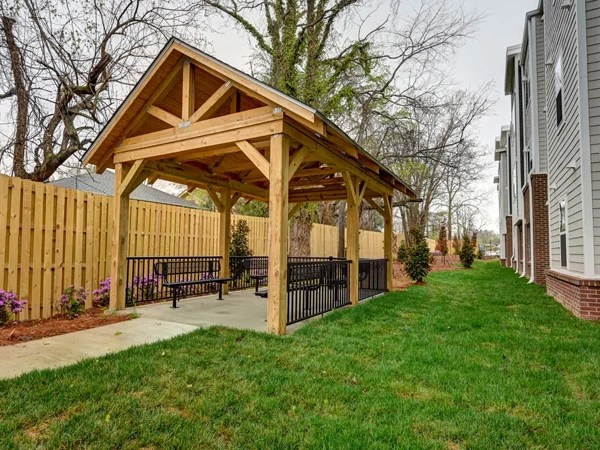
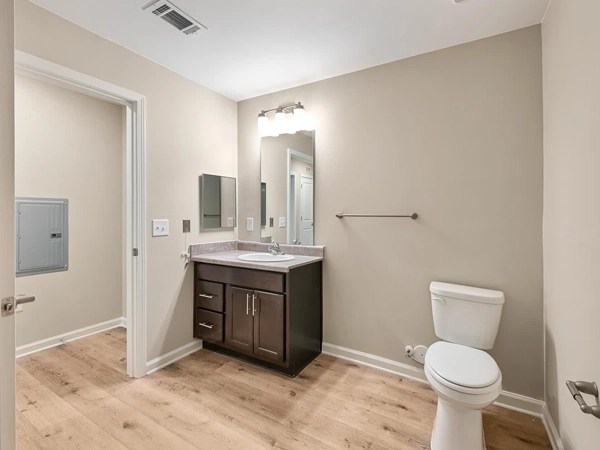
Hawkins Pointe supports residents aging in place with 43 one- and two-bedroom units for seniors aged 55 and older earning between 30 and 80 percent of the area median income. The building has an elevator, hearing-impaired units, and fully accessible units with roll-in showers and low counters. Resident amenities include a computer room, a fitness space, and a community room that also houses a manager’s office. In addition, residents also can enjoy exterior spaces such as a second-floor balcony and gazebo.
Receive the latest stories in your inbox every day — FREE!
Site Challenges
The site presented several challenges for the developer. After site acquisition, Woda Cooper arranged a series of predevelopment meetings with the city to rezone the site, which was then a medical, institutional, and cultural zoning district, as an urban residential conditional zoning district. As part of the rezoning process, the developer presented a preliminary site plan at a community meeting. Neighbors at the meeting raised concerns about the development’s building height, scale, and compatibility with the single-family homes and historic district adjacent to the project. Following this feedback, the developers incorporated design revisions, such as reducing the proposed four-story building to a four-three split level. Nevertheless, the planning commission voted against the project, and the developer continued direct engagement by meeting individually with council members and adjacent neighbors to determine solutions. Additional concessions included further reducing the project’s height to 3 stories, reducing the number of units from 60 to 43, and making site-specific accommodations for neighbors. Cooper explained that, after countless hours meeting with neighbors on their porches, the developer made other changes, including adding assigned parking spots.
Construction and Hurricane Helene
As construction progressed, Hurricane Helene devastated western North Carolina and delayed the project by more than 6 weeks. Although the building remained intact, power and cell service outages disrupted construction operations. Construction crews adapted their work methods and traveled offsite to access cellular phone service and maintain communications.
During this period, the need for stable housing became more urgent, particularly for seniors who were temporarily housed in hotels due to the storm and awaiting permanent options. The developer partnered with the city and Mountain Housing Opportunities, a regional nonprofit leader providing housing solutions for over 2,000 households in Western North Carolina each year, to connect seniors to units as they came available.
Supporting the City’s Goals
City staff perceive Hawkins Pointe as a successful demonstration of how localities can deliver government-subsidized housing (via LIHTC). According to Matthew Manley, long-range planning manager at the city of Hendersonville Community Development Department, Woda Cooper’s commitment to engaging directly with neighbors and maintaining open communication with city staff created trust during the development process. Manley believes the developer understood “the full need or impact of the affordable housing crisis in [our] community.” Since working with Woda Cooper to realize Hawkins Pointe, Manley stated that the city council, which signed a letter of support for the project’s tax credit application, has embraced the need to build additional housing and that the project reflects the city’s goal to address a shortage of more than 2,000 housing units affordable to residents earning up to 80 percent of the area median income.
The contents of this article are the views of the author(s) and do not necessarily reflect the views or policies of the U.S. Department of Housing and Urban Development or the U.S. Government.
You must be logged in to post a comment.