
Ayres, a landscape artist from back East who had come to California in the Gold Rush, was awestruck by a mountainous realm of waterfalls and jagged peaks that seemed more akin to myth than just the new state of California.
Source: Library of Congress
Posted By Maria Peña
Photos: Courtesy
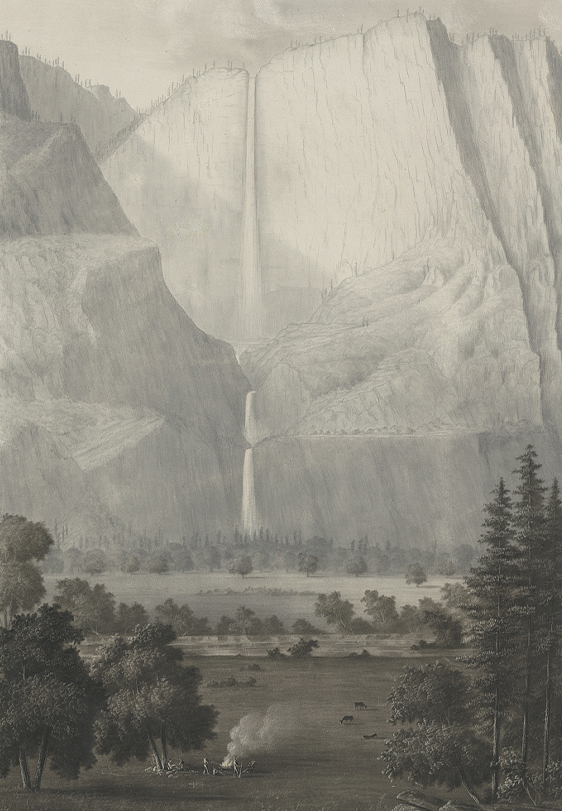
Cover Photo Caption: Thomas A. Ayres “The High Falls, Valley of the Yo Semity, California,” published in 1855. Prints and Photographs Division.
It was a hot day in late June 1855. Thomas Almond Ayres and a small group of adventurers made their way along mountainous, rugged trails into Yosemite Valley, a place almost completely unknown to the larger world.
It was breathtaking: Ayres, a landscape artist from back East who had come to California in the Gold Rush, was awestruck by a mountainous realm of waterfalls and jagged peaks that seemed more akin to myth than just the new state of California.
For the next five days, Ayres sketched and refined with graphite, ink, chalk and charcoal on paper. One of his first drawings, “The High Falls, Valley of the Yo Semity, California,” measuring 20 by 14 inches, depicts what is now known as Yosemite Falls.
When it (and a companion lithograph) was published a few months later, Yosemite became a sensation, enchanting the rest of the country just as Ayres himself had been. His images predated the famous photographs by Carleton Watkins and the monumental paintings by Albert Bierstadt in the 1860s that would cement the valley’s reputation as the romantic dream of the American West incarnate.
The Library recently acquired “The High Falls” sketch and its companion lithograph, preserving them — and their moment in national history — for generations to come.

Heather Wanser of the Conservation Division attends to Thomas Ayres’ 1856 sketch of Yosemite Falls. Photo: Shawn Miller.
“Ayres’ drawing is amazing for conveying the serenity and majesty of Yosemite,” said Sara W. Duke, the Library’s curator of popular and applied graphic art.
“The High Falls” shows small human figures gathered around a flickering campfire in the foreground, smoke curling upward and dissolving into stillness. The peaceful scene is dwarfed by towering granite cliffs and a silver ribbon of waterfall cascading in the distance. He signed it “Thos. A. Ayres.”
The companion lithograph, “The Yo-Hamite Falls,” measuring 23 by 15 inches, was issued by publisher James Mason Hutchings in October 1855.

More than 170 years after Ayres sketched Yosemite Falls, it continues to enchant visitors. Photo: Carol Highsmith. Prints and Photographs Division.
Here’s how Ayres described his initial impressions of Yosemite Falls in print the next year:
“… the first object that attracts our attention is the Cascade of the Rainbow, descending into the valley on our right from a height of nine hundred and twenty eight feet,” he wrote. “The water comes over the sharp granite edge of the precipice, then descending, is broken into fleecy forms, sometimes swayed hither and thither by the wayward winds; at other times the sun lights up its spray with all the colors of the rainbow, hanging like a prismatic veil from the sombre cliff.”
And then:
“As we proceeded onward we were held in silent awe by the subline proportions of ‘El Capitan,’ or the Chieftain of the Yohemity — a cliff of granite lifting its awful forms on the left to the height of three thousand one hundred feet – a sheer precipice jutting into the valley.”
Before Yosemite Falls and El Capitan became famous, before roads, railings, mass tourism and presidential efforts to preserve it, Ayres, 39, and his five-man expedition climbed steep, unguarded trails where a single misstep could send horses and riders tumbling into ravines. The group followed paths and swollen creeks, led by two Miwok guides under the auspices of Hutchings, a shrewd English-born entrepreneur determined to promote and preserve California’s natural wonders.
Native Americans had lived in the region for thousands of years before the Spanish first tried to colonize the area in the 18th century. After the 1849 Gold Rush, California became a U.S. state in 1850. The Mariposa Battalion of the California Militia were the first people of European descent to see Yosemite the following year, raiding Native American settlements as part of a regional war.
Hutchings, the publisher, learned of the valley from a newspaper account of the battalion’s raid. He hired Ayres to accompany him to Yosemite to sketch images for publication in his Illustrated California Magazine.
Ayresand Hutchings wanted everyone else to see what they had, too.
“Instead of saying ‘Let’s mine it for gold’ (Ayres) says, ‘Let’s preserve this. It’s a place that deserves to be preserved as a sacred space for everybody to enjoy,’” Duke said.
A mover and shaker, Hutchings lived to see Yosemite converted to a state park in 1864 and a national park in 1890.
Ayres continued sketching expeditions in California but with fateful consequences. In 1858, after finishing work in Southern California for Harper’s Weekly, he boarded a schooner bound for San Francisco. Concerned about its safety, he switched to another one that he thought was safer. But his new ship sank in rough seas; Ayres drowned, his drawings lost. (The risky schooner he avoided made it safely to port.)
If you’re ever inspired by Yosemite, tip your hat to Ayres, an underrecognized but pivotal figure whose drawings introduced Yosemite to the nation and paved the way for generations of artists and photographers documenting its unparalleled beauty.
You must be logged in to post a comment.