

Bruce Berman, New Mexico State University photography professor and author of “A History of Dust.” (Photo by Eva Alina Bello)
New Mexico State University photography professor Bruce Berman braved these haboobs of the borderland to document the experience, juxtaposing his images with those taken during the Dust Bowl of the 1930s and turning his observations into a book titled “A History of Dust.”
Source: NMSU Newsroom
By Minerva Baumann
Images: Courtesy
The dust storms of the 1930s witnessed swirling black blizzards so dense that people could not see their own hands in front of their faces, completely obliterating the sun for hours.
The Southwest dust storms in 2025 reached intensities not seen since the Dust Bowl, with El Paso, Texas experiencing its most intense and frequent storms since 1936 due to intense drought and high winds. By early May 2025, El Paso had recorded 26 dust storms, far exceeding its annual average of 2.2.
New Mexico State University photography professor Bruce Berman braved these haboobs of the borderland to document the experience, juxtaposing his images with those taken during the Dust Bowl of the 1930s and turning his observations into a book titled “A History of Dust.”


Photos from “A History of Dust” by Bruce Berman. Photos in the book “A History of Dust.” Top Left: April 1936 Library of Congress photo; Top Right: March 2025 Bruce Berman photo of downtown El Paso. Bottom Left: “Fleeing on Dyer Street, El Paso, Texas, by Bruce Berman, March 6, 2025.”; Bottom Right: “Dust Storm, Cimarron County, Oklahoma, by Arthur Rothstein, April 1936. (Library of Congress)
“When the dust storms came here, and everybody was saying, ‘I’ve never seen anything like this.’ This was a record dust storm. I didn’t care, I just wanted to go out into it,” Berman said. “It was perfect for me. Nobody on the street except for a few people. It’s very visual, very different. I shot every dust storm I could get to. I don’t know if I shot every one of them, but I shot most of them.”

The National Weather Service categorizes dust storms into distinct meteorological and visibility categories. A blowing dust advisory is issued when widespread or localized blowing dust drops visibility to 1 mile or less, but stays greater than a quarter mile, and winds of 25 miles per hour or greater are expected. A dust storm warning is issued when a dangerous dust storm reduces visibility to a quarter mile or less and often features sustained winds or frequent gusts of 25 miles per hour or greater. Travel is highly discouraged, as visibility drops to near zero.
So, of course, that’s when Berman went out with his camera to capture the drama of the dust storms. From early March through June 2025, Berman drove into the massive walls of blowing desert sands.


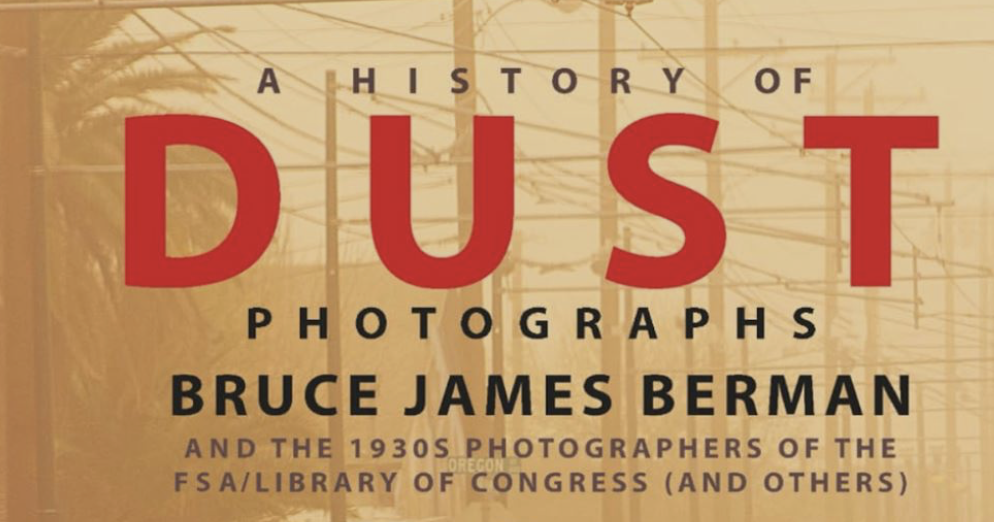
Left: Courtesy book cover image, Right: Photo of Bruce Berman’s mother. Pauline Lucille Farley in May 1935. (Courtesy photo);
“Why would I even want to be out in the dust storm? I don’t know. That’s just me. But I kind of loved the dust storms,” Berman said. “Even the first day I got to El Paso in 1975, I was in awe of them. Remember those dust storms way back when they used to blow over billboards. Those were record dust storms that we had back then.”
Berman’s book follows in the footsteps of photographers working for the Farm Security Administration (FSA) in the 1930s, matching with the historic images of Arthur Rothstein, Dorothea Lange, Russell Lee and other photographers of the FSA. The similarities of the two eras are striking and give great insight into their impact.
Berman reviewed thousands of images of the FSA photographers available in the Library of Congress. The Dust Bowl covered roughly 100 million acres across the Texas and Oklahoma Panhandles, extending into adjacent parts of Colorado, Kansas, and New Mexico.
“I’m looking at the pictures on my computer and I’m thinking, ‘there’s an image there that sort of fits my image’ and I go look at the catalog and boom, it’s there,’” Berman said. “The image fit and it’s 2025 and so I could do a whole book.”
Berman chose to be part of the atmospheric curtain blanketing the borderland in 2025, to seek something primal like stories he’d heard from his mother as a child. The result is a book that blends Southwest dust storms of mythic proportion with a very personal connection.
Dalhart, Texas – located in the far northwest corner of the Texas Panhandle – served as the literal epicenter of the Dust Bowl of the 1930s. The “Black Sunday” storm dropped temperatures by over 50 degrees and completely blotted out the sun, turning afternoon into midnight. Dalhart and the surrounding counties were ground zero.
“In the afterward of the book there’s a picture of my mom in 1935 at 18 years old in Dalhart, Texas. She was there in the Dust Bowl,” Berman said. “She’d say, ‘oh yeah, we used to have to climb a sand dune to get into the second story window to get into the house.’ Me and my sister would roll our eyes. But it was true. One dust storm in the Dust Bowl was considered the worst recorded dust storm in American history. It was called ‘Black Sunday,’ and the epicenter of ‘Black Sunday’ was Dalhart. My mom was telling the truth.”
This book is dedicated to Berman’s mother.
“I love this book. It’s for my mom, Pauline Lucille Farley Berman, who survived the dust storms of the Texas Panhandle and lived the rest of her years with that same courage and resilience.”
You must be logged in to post a comment.