
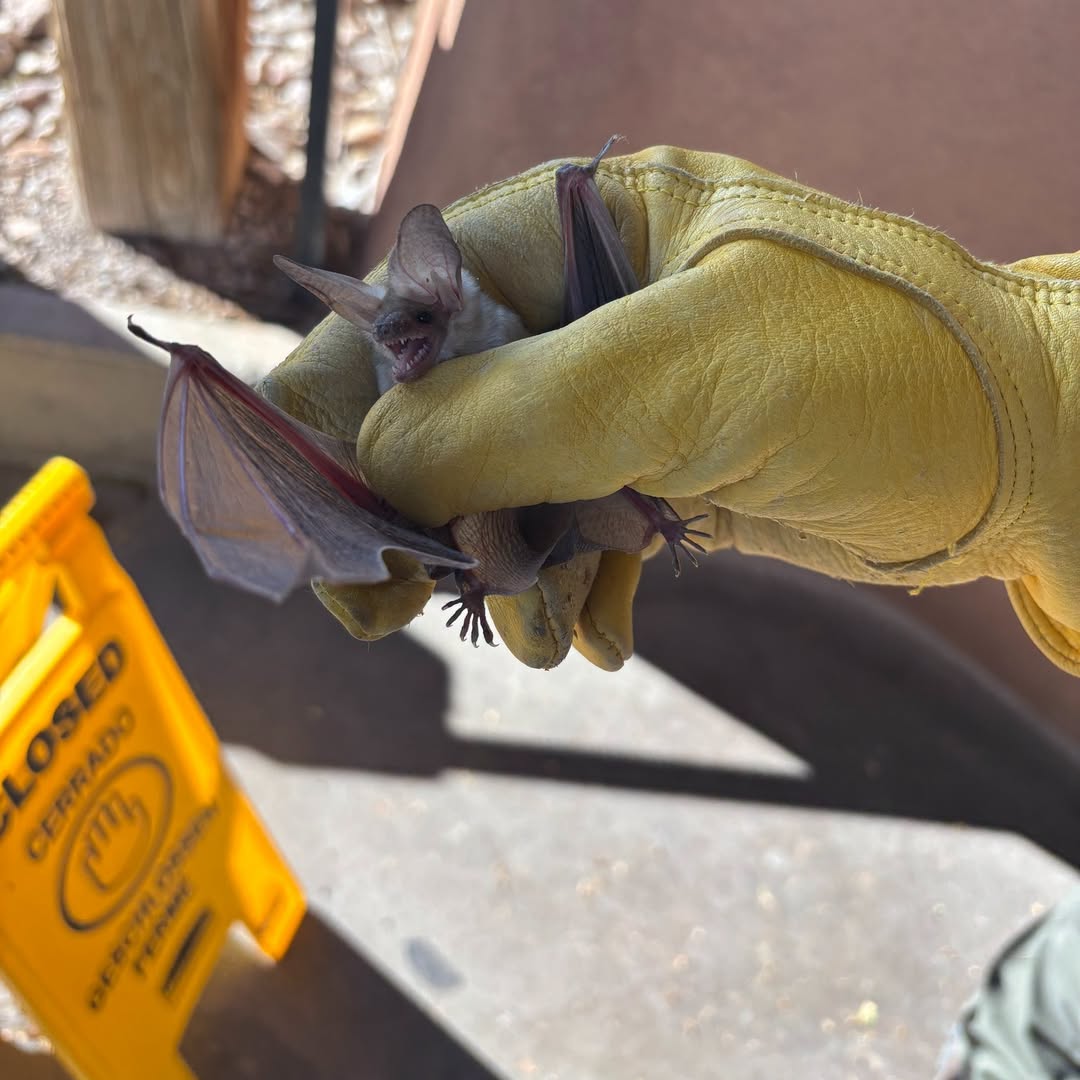

White Sands National Park explains that pallid bats are common throughout the deserts of the American West and are especially prevalent at the park.
Sources: New Mexico Department of Health, White Sands National Park (via Facebook)
Photos: Courtesy National Park Service (Cover Photo Courtesy Paige G.)
LAS CRUCES, N.M. – Visitors to White Sands National Park may notice some tiny new residents this summer. According to White Sands National Park, baby pallid bats are appearing throughout the park, particularly around the visitor center, where the desert-dwelling mammals often roost during the day before emerging at night to hunt insects. Park staff say visitors may even spot the bats inside the visitor center or restrooms, but they ask that people admire them from a distance and never attempt to touch or handle them.


National Park Service Photos by Allison G. (Courtesy)
White Sands National Park explains that pallid bats are common throughout the deserts of the American West and are especially prevalent at the park. During the day they seek sheltered roosting locations, including areas around the visitor center, before flying low over the dunes after sunset to hunt insects and other prey. While the bats may appear harmless—even “cute,” as park staff describe them—officials stress that they should never be disturbed. If visitors encounter a bat that is sleeping, awake, on the ground, acting unusually or appears to be in danger, they should notify a park ranger or staff member rather than attempting to move the animal themselves. The park also advises anyone who is bitten or scratched by a bat to immediately wash the affected area thoroughly and seek medical attention.
The park’s reminder comes as the New Mexico Department of Health is urging residents statewide to exercise caution around bats after a bat found inside a Sandoval County home tested positive for rabies. The animal was euthanized and tested by the department’s Scientific Laboratory Division, with all exposed people and animals receiving post-exposure vaccinations to prevent disease.

“Rabies is nearly 100% fatal, but 100% preventable,” said Dr. Erin Phipps, the New Mexico Department of Health’s state public health veterinarian. She noted that state law requires all dogs and cats to be vaccinated against rabies and warned that unvaccinated pets exposed to the disease must either be euthanized or quarantined for four months to protect public health.
According to the New Mexico Department of Health, bats are the wildlife species most commonly found carrying rabies in New Mexico, although foxes, skunks and bobcats also test positive from time to time. The state confirmed 13 rabid animals in 2025 and 12 in 2024. Health officials emphasize that all mammals are susceptible to rabies and that infected wild animals may behave aggressively, show no fear of people or, conversely, appear unusually tame.

The department advises anyone who has direct contact with a bat, wakes to find a bat in their room or cannot reliably determine whether contact occurred to receive rabies post-exposure vaccination. Residents are also encouraged to keep pets current on their rabies vaccinations, avoid handling wild animals, seek veterinary care if a pet is bitten or scratched, and immediately wash any bite or saliva exposure with soap and water before seeking medical attention. Suspected rabies exposures should be reported to local animal control, while questions can be directed to the New Mexico Department of Health Helpline at 1-833-SWNURSE (1-833-796-8773) or by texting NMDOH to 66364.
You must be logged in to post a comment.