

Recent posts from White Sands National Park highlighted some of those easily overlooked details — beginning with the material beneath visitors’ feet.
Source: White Sands National Park (via Facebook)
Photos: Courtesy
Cover Photo: NPS Photo/Brendan Youmans
The brilliant white landscape of White Sands National Park may appear sparse from a distance, but a closer look reveals a landscape filled with unusual geology, animal tracks and creatures adapted to life among the dunes.
Recent posts from White Sands National Park highlighted some of those easily overlooked details — beginning with the material beneath visitors’ feet.
The “Sand” Is Gypsum
White Sands is part of the largest gypsum dunefield in the world, but the mineral responsible for the park’s distinctive landscape has properties extending well beyond its appearance.
Gypsum is a soft, hydrous sulfate mineral known chemically as calcium sulfate dihydrate. That means water is incorporated into the mineral itself.

Courtesy Photo Credit: NPS/Paige G.
When gypsum is heated and that water is removed, it can become the chalky material commonly known as plaster of Paris. Add water again and the material rehydrates and hardens.
That versatility has made gypsum useful in products ranging from drywall to toothpaste.
At White Sands, however, enormous quantities of the mineral have produced something altogether different: dunes where visitors hike, sled and watch sunsets across a landscape unlike almost anywhere else.

Tiny Dinosaur Tracks? Not Quite
Some of the park’s smaller residents leave evidence behind even when the animals themselves are nowhere to be seen.
A set of three-toed tracks photographed in the sand might resemble the footprints of a tiny dinosaur, but park staff identified the likely culprit as a much more familiar animal — a horned lark.

Courtesy NPS photo/Allison G.
The birds spend considerable time on the ground, foraging for seeds and insects and gathering grasses for their nests.
The photographed tracks appeared to document one bird’s journey toward a young green plant growing from the sand.
For observant visitors, tracks like these provide clues to activity that may have occurred long before anyone arrived to see it.
A Grasshopper Among the Dunes
Other residents are considerably easier to spot.
White Sands recently highlighted a traveler grasshopper, a species found across the southern United States and into Mexico and Central America.

Courtesy Photo Credit: NPS Photo/Allison G.
Grasshoppers are daytime-active herbivores that feed on a variety of plants. While one might occasionally be found resting among the open dunes, visitors are more likely to encounter them where vegetation is plentiful.
One such location is the park’s Dune Life Nature Trail, where plants provide both food and habitat for insects and other wildlife.
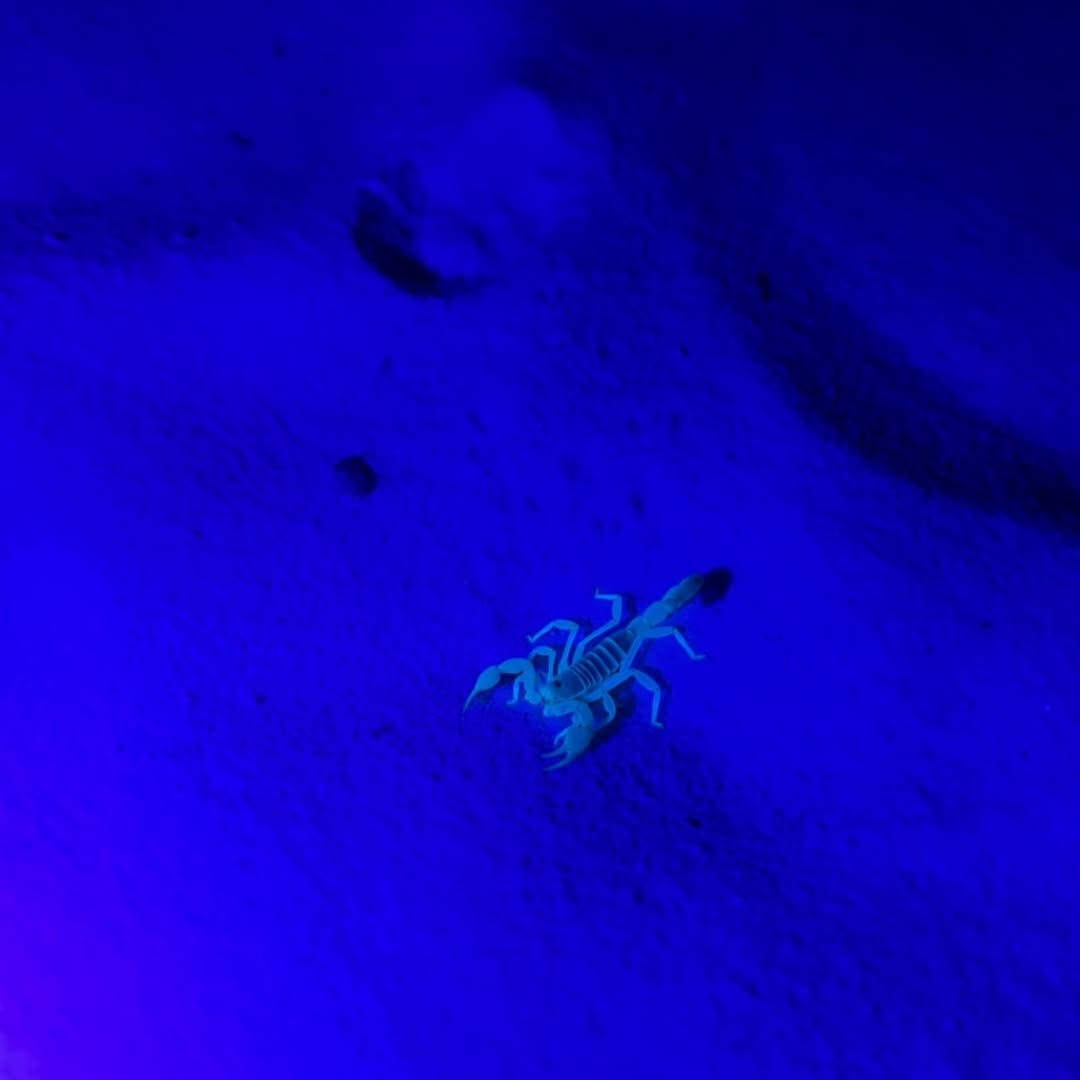
A Scorpion That Glows
After sunset, another White Sands resident offers an entirely different spectacle.
Scorpions are naturally fluorescent under ultraviolet light. Chemicals within their exoskeletons absorb ultraviolet radiation and re-emit it as visible light, producing the striking green glow seen when a scorpion is illuminated with a UV light.

Courtesy Photo Credit: NPS Photo/Brendan Youmans
The arachnids are nocturnal and use sensitive vibration receptors to locate insects, spiders and other prey.
Their venom is primarily used to capture prey, although it can also serve as a means of defense.
Despite their intimidating appearance, scorpions also play an important ecological role by helping control insect populations.
Visitors who encounter one should admire it respectfully and give it space.
A Landscape Worth Looking At Twice
White Sands may be best known for sweeping views of brilliant gypsum dunes, but much of the park’s story is written on a considerably smaller scale.
A footprint crossing the sand, a grasshopper among the vegetation or a scorpion emerging after dark can reveal a landscape considerably more active than it first appears. Sometimes the best way to explore White Sands isn’t to look toward the horizon.
It’s to look down.
You must be logged in to post a comment.