

NMSU Police Chief Justin Dunivan will also host a public discussion later this month addressing campus safety, recent crime statistics and trends, and steps members of the university and Las Cruces communities can take to help prevent crime.
By Levi Gwaltney for Las Cruces Digest
Source: NMSU Newsroom
Based on Stories by Minerva Baumann, NMSU Media Relations Officer
Photos by Josh Bachman for NMSU: Courtesy
As students return to New Mexico State University for the fall semester, campus officials are using the beginning of the academic year to emphasize pedestrian safety, crime prevention and emergency preparedness.
The reminders come as increased numbers of students, vehicles, bicycles, utility carts and pedestrians return to campus and the surrounding neighborhoods.


NMSU Police Chief Justin Dunivan will also host a public discussion later this month addressing campus safety, recent crime statistics and trends, and steps members of the university and Las Cruces communities can take to help prevent crime.
More People, More Traffic
NMSU is asking drivers and pedestrians to pay particular attention to their surroundings as activity increases around campus.

Drivers are reminded to observe posted speed limits, eliminate distractions and use care when passing bicyclists and utility carts. Pedestrians are encouraged to remain aware of their surroundings and watch for unexpected vehicle movements.

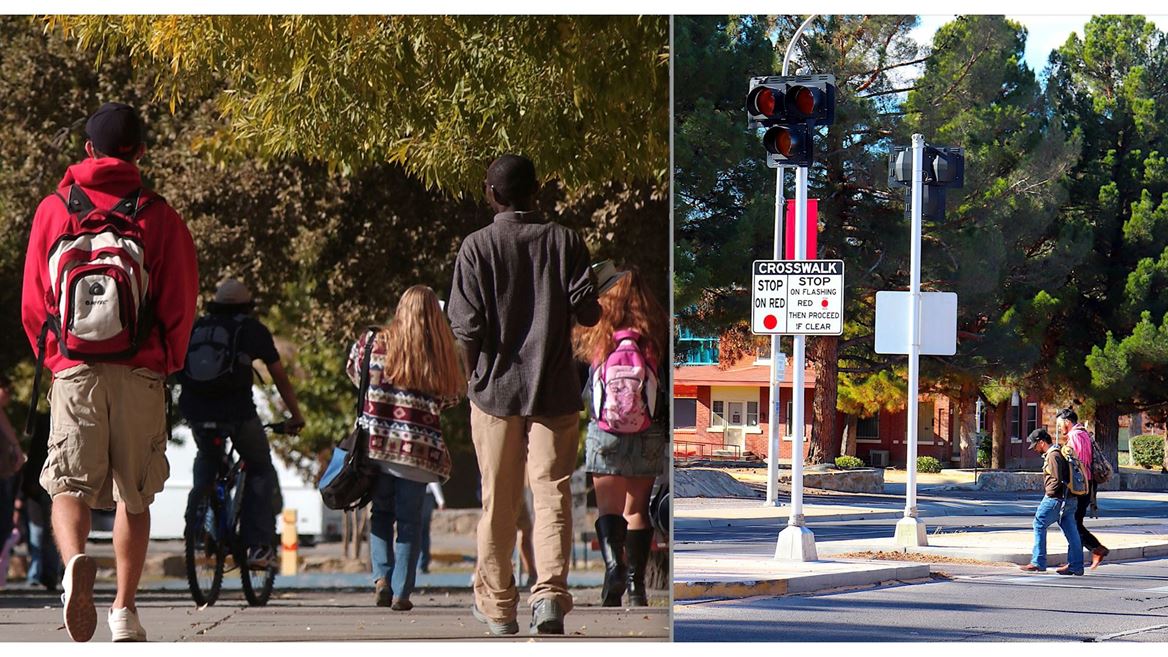
The university is also drawing attention to the high-intensity activated crosswalks found along University Avenue and elsewhere.
When the crosswalk lights are inactive, motorists can proceed normally. A flashing yellow light means drivers should prepare to stop.
When the red lights begin flashing, motorists should stop and allow pedestrians to cross.

Once the crosswalk is clear, the vehicle at the front may proceed. The next driver should then advance to the stop line, come to a complete stop and make sure the crosswalk remains clear before continuing. Drivers should repeat that process until the flashing lights turn off.

Students Returning to Cars and Residence Halls
The beginning of the semester also means students are returning to campus housing and leaving vehicles in university parking areas for longer periods.
NMSU recommends keeping residence hall doors locked, even when occupants are sleeping or leaving for only a short time. Exterior residence hall doors should not be propped open because doing so compromises controlled access to the building.

Students are also encouraged to document valuable belongings, including serial numbers for electronics.
For vehicles, NMSU recommends closing windows and locking doors regardless of how briefly the vehicle will be unattended. Laptops, bags, documents and other valuables should not be left visible inside.
Students walking to and from vehicles should remain aware of their surroundings and, when possible, use authorized, well-lit parking areas.
Suspicious activity in campus residential areas can be reported to NMSU Police. The department’s non-emergency number is 575-646-3311.
A Conversation With the Police Chief
The campus-safety discussion will continue Monday, Aug. 24, when Dunivan hosts “Bridge the Gap” at 12:30 p.m. in Room 304 of the Corbett Center Senate Gallery.

Students, faculty, staff and members of the Las Cruces community are invited.
Dunivan plans to discuss recent crime statistics and trends, hear community concerns and offer crime-prevention information.
“When we gather together, it breaks down barriers and builds the trust necessary for real communication,” Dunivan said. “It gives us a chance to share the actual data, dispel rumors and provide actionable tips that can keep people on campus and our greater community from becoming a victim of crime.”
Preparing for Larger Emergencies
Behind the day-to-day safety preparations, NMSU departments are also being asked to update their plans for larger emergencies.

The university maintains an All Hazards Emergency Operations Plan integrated with the Doña Ana County Office of Emergency Management. Individual colleges, departments and offices are also required to maintain their own emergency action plans.
Those plans address department-level responses to emergencies including natural disasters, fires, hazardous-material spills and active-shooter situations, with the objective of moving employees, students and visitors to safety as quickly as possible.
NMSU’s Emergency Planning Committee is asking departments that have not yet updated their plans to do so before the Sept. 30 deadline, ensure employees understand the plans and maintain an accessible printed copy within the department.
NMSU Police, Fire and Environmental Health, Safety and Risk Management work together on campus safety and emergency preparedness, while university officials are emphasizing that students, employees and visitors also have a role as another academic year gets underway.
You must be logged in to post a comment.