
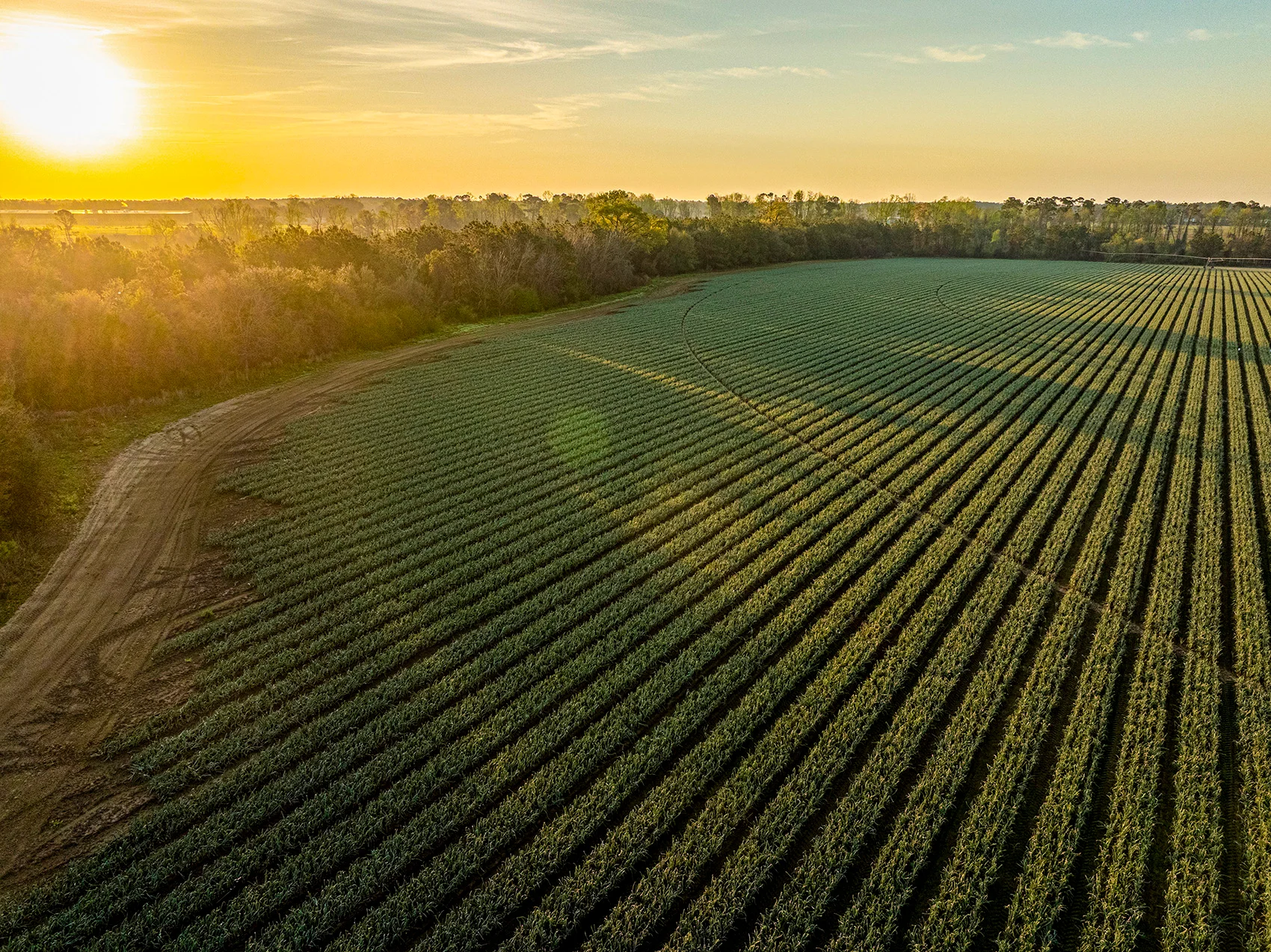

Bland Farms revolutionized how Vidalia onions are marketed. Four decades later, they’re pushing the industry forward again through university partnerships, eco-friendly farming, and high-tech field management.
Source: University of Georgia CAES
By Maria M. Lameiras
Original Design By Katie Walker
Photos: Courtesy
In 1982, Delbert Bland planted a small plot of sweet onions on his father Raymond’s 50-acre farm in southeast Georgia — land the family had worked since the late 1950s, starting with peanuts and corn before adding tomatoes.
It wasn’t a bold move yet. Just a test.

The following year, Bland Farms placed a small ad in Southern Living magazine. It was the first time anyone had marketed Vidalia onions nationally. The industry took note.
Rubye Jean Bland and her grandson, Landis Bland, get ready for Bland Farms’ very first Vidalia onion season in 1983. (Submitted photo)
Four decades later, Bland Farms is Georgia’s largest grower, packer and shipper of Vidalia and other sweet onions. The company grows or contracts roughly 3,000 acres across Georgia, Texas, Nevada and California, with an additional 2,400 acres in Peru and 800 in Mexico. In a typical year, that adds up to 5 to 6 million boxes — or 5,000 to 6,000 truckloads.
Vidalia onions are harvested in April and May and sold through November. Onions from other regions fill out the calendar, keeping Bland Farms sweet onions available year-round.

Acres of Vidalia onions glow in the sunrise at Bland Farms. (Photo by Benjamin Galland)
Pioneering high-tech onion production
The company has worked to shrink its environmental footprint as it’s grown.
Conservation tilling reduces soil erosion and runoff. Unsold onions are diced or whole-peeled for industrial use rather than discarded. Onion material left over at harvest goes back into the fields as natural fertilizer. In 2021, Bland Farms received the Pratt Environmental Impact Award for a decade of sustainable packaging, using 100% recyclable e-bags.
Inside the operation, full-time agronomists, quality control experts and food safety specialists manage daily decisions, but Bland Farms CEO Troy Bland said the company maintains a close relationship with the University of Georgia’s College of Agricultural and Environmental Sciences and UGA Cooperative Extension.
“UGA has been very helpful to us with evaluating new varieties, as well as herbicide and fungicide treatment plans throughout the years,” he said.

A tractor pulls a LaserWeeder down rows of Vidalia onion starts at Bland Farms in Lyons, Georgia. Sensors scan the ground for weeds and targets them with a precision burst of heat and light, killing them at the root. The method does not disturb plants or soil and can be a beneficial tool in organic farming due to the lack of chemicals. (Photo by Katie Walker)
Bland Farms was also the first grower in the industry to use the LaserWeeder, a robotic precision agriculture tool that enables direct seeding. Based on last season’s results, the company will add a second unit for the next growing cycle.
Receive the latest stories in your inbox every day — FREE!
Bland, a member of the dean’s Advisory Council for the College of Agricultural and Environmental Sciences, is watching the UGA Grand Farm project in Perry, Georgia, with interest — particularly for what it might mean for harvest and post-harvest labor, which he calls the industry’s greatest challenge ahead.
“We are excited to see what can come from that initiative,” he said.

Lee Lancaster details the history of Vidalia onions from Mose Coleman’s original seed order in 1930 to becoming Georgia’s most beloved allium in his book, “Vidalia Onions: A History of Georgia’s State Vegetable.” (Photo by Katie Walker)
The onion that belongs to Georgia
Lee Lancaster can tell you exactly where a Vidalia onion is from. Not just the state — the specific counties, written into federal law.
“Vidalia onions can only be produced in Georgia,” said Lancaster, marketing specialist for the Georgia Department of Agriculture‘s Georgia Grown program and manager of the Vidalia Onion Program. “Only 10,000 acres are grown annually — the same amount as Georgia peaches and less than 1% of the cotton grown in the state.”
That exclusivity is part of what makes the Vidalia something more than a grocery staple. It’s considered the sweetest onion in the world — its trademark sweetness comes largely from southeast Georgia’s sandy soils and climate, which limit sulfur availability and reduce pungency — and it ships to all lower 48 states and Canada.
Lancaster, a 2000 graduate in agricultural education from CAES, spent months chasing the crop’s full story. In 2023, he published the result, a book titled “Vidalia Onions: A History of Georgia’s State Vegetable.”
But the onion’s modern reach almost didn’t happen.
For most of its early history, the Vidalia had a fatal flaw: it lasted barely more than a month after harvest. That short shelf-life capped production at around 1,000 acres — not because growers didn’t want to plant more, but because the delicate crop would rot within a couple of months of harvest when stored.

Archival photo of Doyle Smittle in his UGA-Tifton lab, where he researched controlled atmospheric storage on Vidalia onions. (Submitted photo)
A cool solution for a booming market
UGA research scientist Doyle Smittle decided to fix that. He looked north, to Michigan, where apple growers had developed a method called controlled atmosphere cold storage — a way to hold fruit in a low-temperature, oxygen-reduced environment for months without losing quality. Smittle spent nearly a decade adapting that technology for onions.
In 1989, the first controlled atmosphere facility for Vidalia onions opened between Alamo and Helena, Georgia. It could hold 3 million pounds of onions.
“Right after the introduction, production went up to 2,500 acres, then a high of 15,000 acres about 15 years ago,” Lancaster said.
Today, about 100 growers farm roughly 10,000 acres — down from more than 250 growers in the 1980s but sustained by the science that made it possible.
Much of that work takes place through UGA’s Vidalia Onion and Vegetable Research Center in Lyons, Georgia, where scientists, Extension specialists and growers collaborate on solutions tailored specifically to the unique crop.

Harnessing science for sweeter, stronger crops
While controlled-atmosphere storage transformed the industry in the 1980s, UGA researchers continue to tackle the challenges that will determine the future of the Vidalia onion industry, from labor shortages and weed management to disease resistance, precision agriculture and automation.
UGA plant pathologists are working to combat center rot, a bacterial disease that has cost growers millions of dollars in losses and remains one of the most serious threats facing the crop. Plant breeders are developing future onion varieties that maintain the sweetness and appearance consumers expect while improving disease resistance and field performance.
Researchers and growers are exploring whether technologies like the AI-guided LaserWeeder could eventually make direct-seeded onion production practical in Georgia, reducing labor costs while maintaining crop quality.
From extending shelf life through controlled-atmosphere storage to tackling weeds, disease, labor shortages and varietal improvement, UGA researchers continue to work alongside growers to protect one of Georgia’s most recognizable crops. Read more about the research helping secure the future of Vidalia onions in the recent CAES Field Report feature, “UGA researchers work with Georgia farmers to protect Vidalia onion quality and sustainability.”
You must be logged in to post a comment.