

Each of these elements is equally important when supporting agencies like CBP, especially when assessing mission-critical technologies before they are selected for deployment.
Source: Department of Homeland Security
Photos: Courtesy
Cover Photo Caption: “We were able to demonstrate NEC’s SmartID Express and Neoface Express in real-world outdoor conditions and weather, successfully capturing high-quality facial images of thousands of pedestrians a day,” said Todd Morris, President of NEC NSS. Photo credit: S&T.
S&T has once again shown that strong technical expertise, trusted partnerships, technological precision, and sound science can operate at full throttle while delivering operational success across the Department of Homeland Security (DHS). Each of these elements is equally important when supporting agencies like CBP, especially when assessing mission-critical technologies before they are selected for deployment.
“In October 2025, CBP approached S&T with a request for solutions that could securely, efficiently, and accurately confirm the departure of pedestrians exiting the U.S. at border crossings using biometrics,” said Arun Vemury, S&T Senior Advisor for Biometrics and Identity. “To meet long-standing legislative requirements and Administration priorities, S&T facilitated the technology demonstration to support CBP in testing cutting-edge technologies to efficiently perform its mission.”


With this new technology, pedestrians can walk past the cameras for identity verification as they cross the border. “Over 1.1 million pedestrians exit the U.S. to Mexico annually, and it is imperative to keep them safely moving,” said Bridge Director Marga A. Lopez. “We were interested in whatever technology S&T could bring down to us that would deliver a secure, streamlined process for pedestrians. We thank S&T and CBP for including us in this innovative pilot program.” Photo credit: S&T.
CBP turned to S&T and its knowledge of the facial biometrics landscape to quickly assess the current state of the market and identify emerging technologies that could meet CBP’s specific needs and high standards for secure border operations.
To support the request, S&T coordinated with federal and industry partners through Cooperative Research and Development Agreements (CRADAs). The goal was to provide analysis to support CBP’s near-term planning and broader border security objectives. By leveraging the CRADAs, S&T enabled the industry partners to work quickly, cover their own costs, and provide the greatest value for informed governmental decision-making.

In early 2026, S&T invited six companies to the Maryland Test Facility (MdTF) for basic capability demonstrations to determine which solutions should be operationally tested. These demonstrations led CBP and S&T to select three solutions for additional data collection: two from NEC National Security Systems (NSS) and one joint solution from Paravision and AiFi.
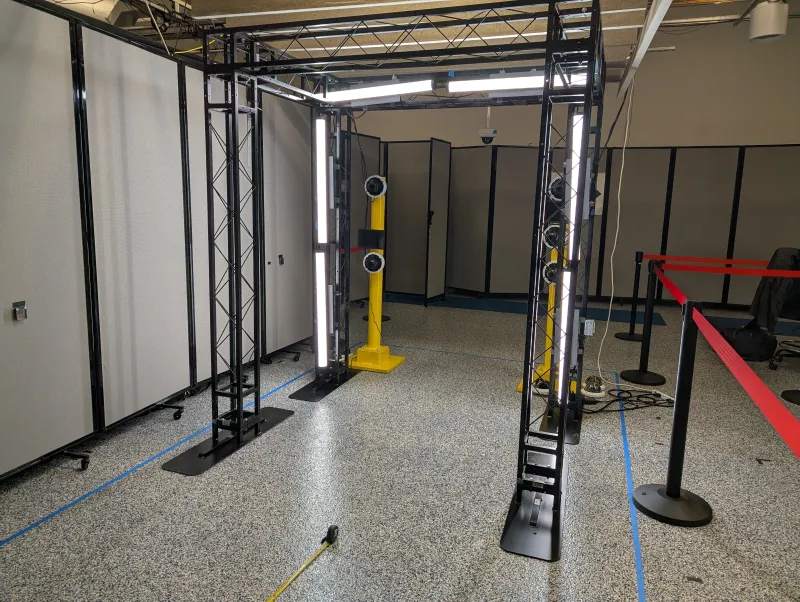
Before deployment, S&T built a replica of the pedestrian exit environment at MdTF so vendors could install and assess their prototypes before taking them to the Progreso border crossing. This helped reduce risk by identifying issues in a controlled environment before testing in an active border environment.
When the industry partners arrived at the Progreso International Bridge in May, they began setting up for the operational assessment that would support CBP’s planning.

U.S. citizens were provided an opt-out lane if they chose not to participate in the image collection testing. Photo credit: S&T.
For the testing to be successful, the technologies had to account for human factors such as travelers’ walking pace, as well as hats, sunglasses, umbrellas and other items people use or carry. Collecting usable facial images outdoors during the day and at night, at speed and scale, is challenging given the many variables.
The partners leveraged artificial intelligence (AI) and other technologies to perform tasks such as constructing a 3D digital environment of the image capture zone, observing pedestrian movement, and analyzing facial images to determine whether they were suitable for biometric matching in CBP’s Traveler Verification Service.
The industry partners installed their products in various configurations. Some cameras were mounted on poles at different heights to account for individuals of different statures.
The Science and Technology Directorate (S&T) recently brought industry partners to the Progreso International Bridge border crossing in Texas to demonstrate facial biometric capabilities for U.S. Customs and Border Protection (CBP). The effort supports S&T’s priority to help secure U.S. borders by identifying, testing, and transitioning technologies that strengthen security while facilitating efficient lawful travel. Hear from S&T, CBP, and our partners about this successful real-world test of secure, easy-to-use biometric technologies and how they capture essential data as pedestrians exit the country.
You must be logged in to post a comment.