

Bill Evans Lake: Jori Gramzow caught this largemouth bass using a creme pre-rigged scoundrel worm while trolling near the dam last month. As she put it, “Bruno the bass couldn’t resist my fake worm!”
Source: N.M. Department of Wildlife
Photos: Courtesy
ATTENTION: Several lakes throughout New Mexico are under Harmful Algae Bloom (HAB) watches or warnings. Be sure to visit the New Mexico Environment Department’s HAB Advisory Map for the latest conditions and advisories before going out.
Southwest New Mexico Fishing Report
- Bill Evans Lake: The most recent report was received Sept. 3. At that time, fishing for bluegill and carp was good when using inline method feeders. Fishing for catfish was fair to good when using chicken liver, bluegill and inline method feeders.
- Bear Canyon Lake: Fishing conditions have been adversely affected in the aftermath of the Trout Fire.
- Caballo Lake: With recent water releases from Elephant Butte and Caballo lakes, water levels are changing across the lake; boaters should exercise caution in low-water areas. For more information, visit the Caballo Lake State Park webpage or call 575-743-3942.
- Elephant Butte Lake: The most recent report was received Sept. 3. At that time, fishing for largemouth bass was fair to good when using spoons from the shore. Due to historically low water levels, vessel launching at the Marina del Sur boat ramp is hazardous because of sediment and debris on the ramp. The South Monticello and Rock Canyon boat ramps remain closed due to low water levels. For more information, visit the Elephant Butte State Park webpage or call 575-744-5923.
- Gila River: Streamflow near Gila on Tuesday morning was 87.9 cfs.
- Gila Waters: Streamflow near Gila Hot Springs on Tuesday morning was 159 cfs.
- Quemado Lake: The lake is currently under a Harmful Algae Bloom Danger Advisory.
- Rio Grande: Streamflow below Elephant Butte Lake was 0 cfs.
- Young Pond: The most recent report was received Sept 3. At that time, fishing for bass was fair to good when using micro 1/16-ounce jigs with micro soft plastics. Fishing for bluegill and sunfish was fair to good when using live red worms or wax worms on a slip float setup No. 8 hook. Fishing for catfish was good when using worms.
N.M. Department of Wildlife received no reports for the following waterbodies over the past three weeks: Escondida Lake, Glenwood Pond, Lake Roberts, Percha Dam, Quemado Lake, Rancho Grande Ponds, Trees Lake, Snow Lake and Whitewater Creek.


What’s the difference between red, green and Xmas?
By: Colleen Payne, M.S.
Southwest Area Public Information Specialist
As New Mexicans, we often have to choose between red, green or Christmas.
Anglers face the same choice when they head to one of the state’s Special Trout Waters. These waters, also known as STWs, are managed to enhance the unique angling opportunities available in New Mexico. Regulations vary for STWs — some are managed to produce trophy-size trout, some to improve conservation of native trout, and others to enhance the overall trout population structure and density.

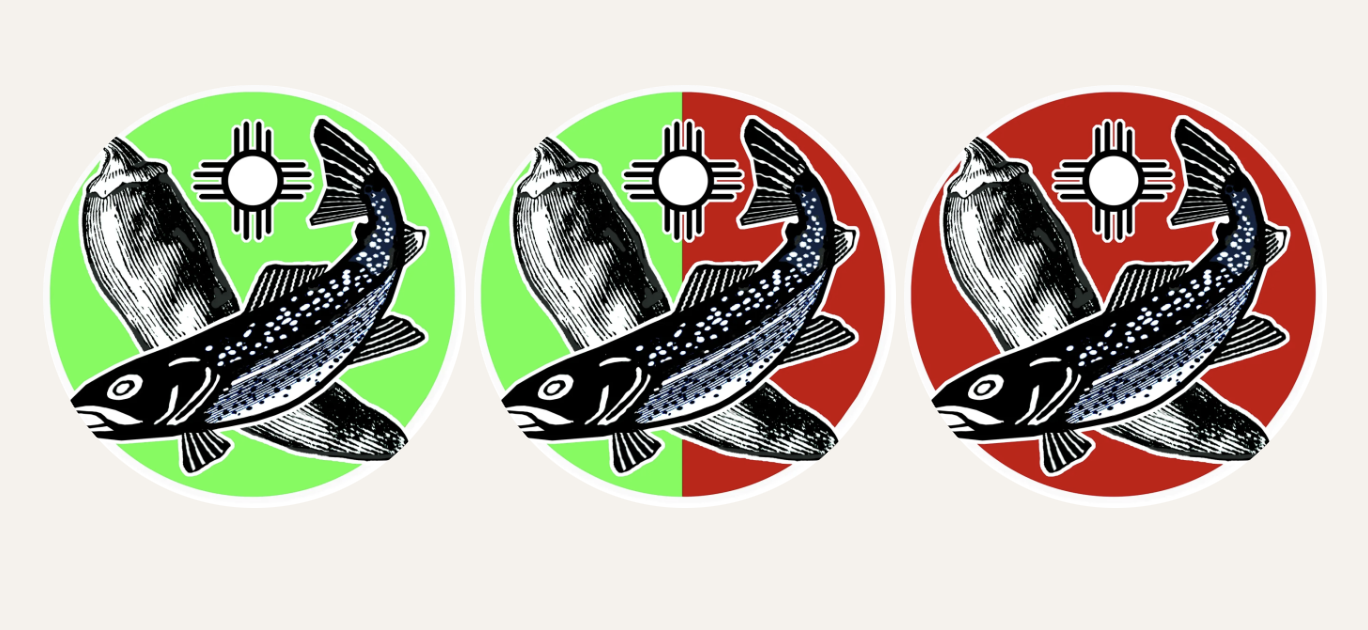
The different sets of STWs are separated into Green Chile, Red Chile and Xmas Chile waters, making them easy to remember and distinctly New Mexican. Regulations are tailored to each water and may include reduced bag limits, catch-and-release for native Gila trout and Rio Grande cutthroat trout or increased harvest for nonnative fish species. Signs with symbols are posted at STWs with bag limits and tackle restrictions. By following these regulations, anglers help to conserve healthy fisheries in New Mexico and promote high-quality fishing experiences for everyone.
Here are the different rules for each type of Special Trout Water:
 | Red Chile Water: Catch-and-release only. Tackle restrictions include an artificial fly or lure with a single, barbless hook. |
 | Green Chile Water: Bag limit of two trout only. Tackle restrictions include an artificial fly or lure with a single, barbless hook. |
 | Xmas Chile Water: Bag limit of two trout only. Any legal tackle may be used. |
Locations of all chile waters are listed on pages 21–23 of the Fishing Rules and Information Booklet.
Several STWs have been established to help protect and conserve Gila trout and Rio Grande cutthroat trout. Non-native trout species can outcompete or hybridize with native trout species. In order to protect native trout species, unlimited bag limits in some waters have been established for nonnative trout species (rainbow, brown and brook trout). These waters are listed on page 22 under Red Chile (Native Trout Conservation).
Many STWs require artificial flies and lures with a single, barbless hook. It is illegal to disturb rocks, plants or sediment to attract fish. Chumming and baitfish use are not allowed in any STW. More than one fly or lure (dry and dropper combination) can be used on a single line in STWs.
All fishing in STWs must stop when the daily bag limit for that water has been taken. Anglers may not continue to fish another STW with a similar or lower bag limit but may continue to fish in waters with a higher bag limit. Anglers must count those STW fish toward their overall daily bag limit.
When fishing in STWs where the bag limit is zero, anglers must not possess any trout.
So, the next time you head out to one of New Mexico’s Special Trout Waters, remember that red, green or Christmas isn’t just a question for the dinner table. Choose your chile wisely, and good luck fishing!
You must be logged in to post a comment.