

If you were a wild animal — or a wilderness survival expert — how would you stay safe from the desert sun or a sudden mountain thunderstorm?
Source: N.M. Department of Wildlife
Article and photos by Colleen Payne
Southwest Area Public Information Specialist: Courtesy
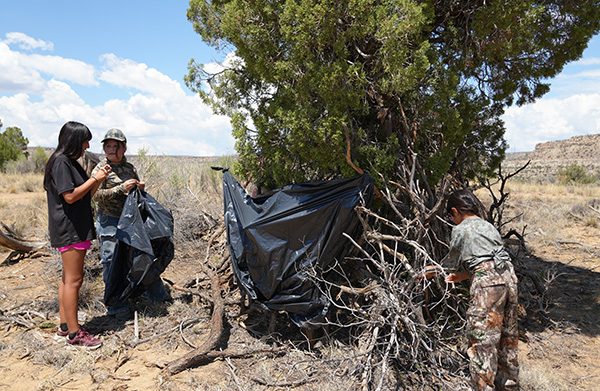
Cover Photo Caption: Participants in a recent Hunter Education camp hosted by the New Mexico Department of Wildlife near Navajo Lake team up to build a temporary shelter.
Hey there, young explorers! Did you know New Mexico is one of the most diverse states in the country? Our landscape ranges from snowy mountains in the north to sunny deserts in the south, providing habitat for all kinds of wildlife.
If you were a wild animal — or a wilderness survival expert — how would you stay safe from the desert sun or a sudden mountain thunderstorm? You might build a shelter! Grab your outdoor shoes and put on your engineering hat. Here’s how you can build a simple nature shelter while exploring the Land of Enchantment.

Before you start building, take a look at the landscape around you. New Mexico’s varied terrain means different environments require different approaches. In southern New Mexico’s desert basins, the sun and wind can be intense. A shelter that provides shade and protection from the wind can help keep you more comfortable.
Look for a safe location near a canyon wall, rock or group of sturdy bushes. Higher elevations can be cold, especially when storms move in. A smaller shelter with a sturdy roof can provide protection from wind, rain or snow.
Receive the latest stories in your inbox every day — FREE!
A lean-to is one of the simplest shelters to build. It uses sticks and other natural materials to create a structure with a sloping roof.
- Do a safety sweep. Look up, down and all around. Check above you for dead branches that could fall. Look at the ground to make sure you aren’t building near a cactus, an insect nest or a wildlife den. Always choose a safe location and have an adult nearby.
- Follow the 3D rule. To help protect New Mexico’s plants and wildlife, collect only wood that is dead, down and detached from living trees. Never break branches from living plants. If a stick is too large or heavy to move safely, ask an adult for help.
- Find the backbone. Look for a long, sturdy branch to use as your ridgepole. Place one end securely against the fork of a tree, a large rock or another sturdy support. Make sure it is stable before continuing.
- Add the ribs. Gather shorter sticks and lean them against the ridgepole. Place them close together to form the frame of your shelter.
- Add insulation. Weave smaller twigs into the gaps, then add fallen leaves, pine needles or dry grass to help block wind and rain. Never use living plants or damage vegetation to build your shelter.
Once your shelter is finished, crawl inside. Does it feel different from the area outside? Does it provide shade or block some of the wind?
For a simple rain test, have a parent or other adult gently spray water over the shelter with a spray bottle or hose. If water gets through, see whether adding more natural, already-fallen materials improves the shelter.
When you’re finished exploring, it’s time to practice Leave No Trace. Carefully take apart your shelter and scatter the sticks and leaves back where you found them. Remove anything you brought with you.
By leaving the area as you found it, you help keep New Mexico’s public lands safe and beautiful for wildlife and the next group of explorers.
You must be logged in to post a comment.