

Early detection of breast cancer – the most common type of cancer diagnosed in women except for skin cancer – dramatically increases the chances of survival for most patients.
Source: N.M. Department of Health
Cover Photo: Courtesy Doña Ana County (via Facebook)
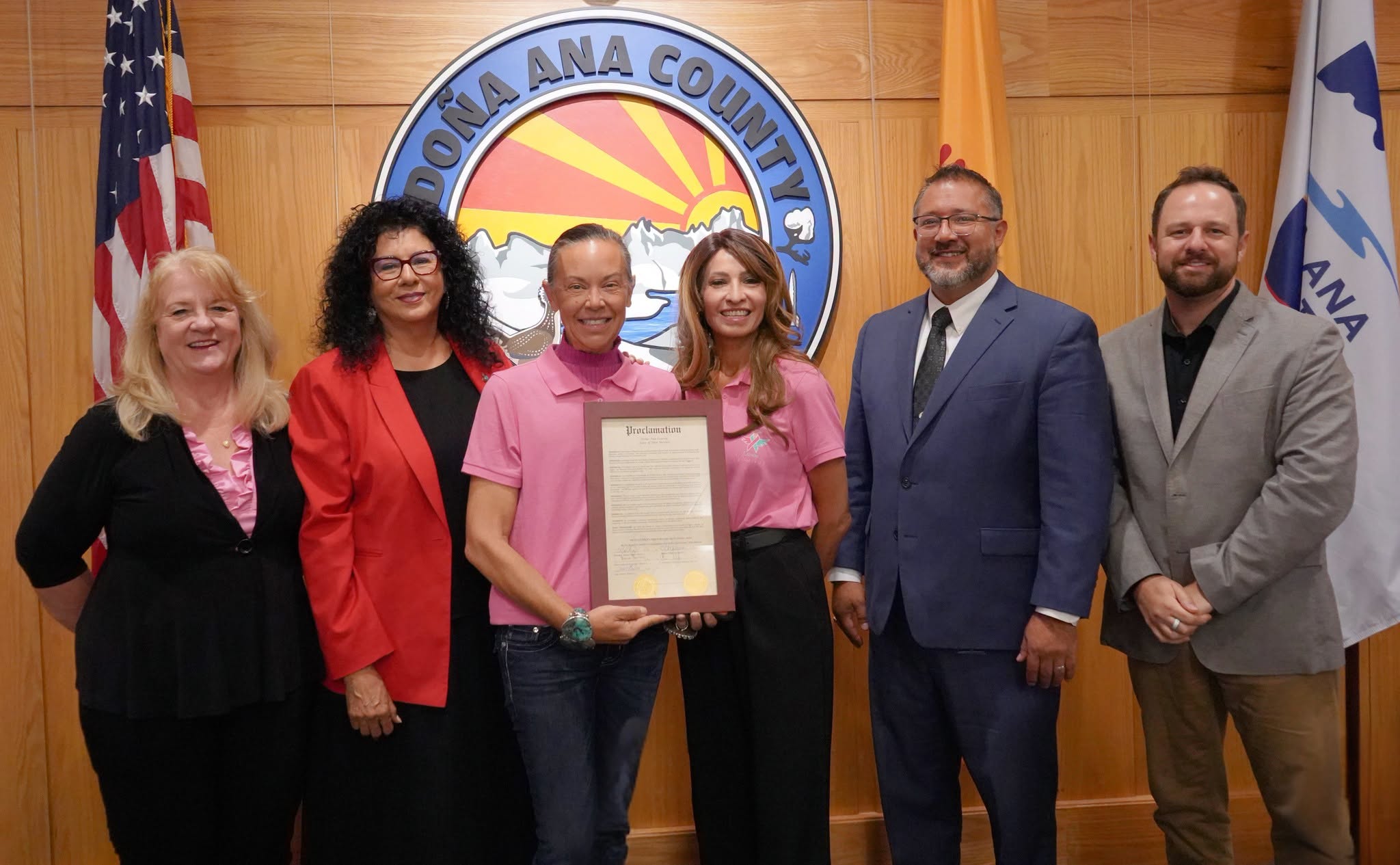
Cover Story Caption: The Doña Ana Board of County Commissioners recently proclaimed October as Breast Cancer Awareness Month, honoring those who fought and won, standing beside those who are still fighting, remembering those who fought until the end, and recognizing those who may one day face this battle. “We were honored to recognize the Cancer Warriors of Las Cruces, an organization that helps local women and families navigate their cancer journeys through mammogram assistance, care packages, fundraising, and community activities.” (Courtesy Doña Ana County Government Center via Facebook)
SANTA FE – Low-income, uninsured women in New Mexico can get free breast cancer screenings and follow-up tests through the New Mexico Department of Health, and during National Breast Cancer Awareness Month this October, the department is encouraging every woman to talk with a health care provider about when to start getting mammograms.

In honor of those who have bravely battled breast cancer, those who are currently fighting, and those whose lives have been touched by this disease, the NMDOT General Office in Santa Fe walked to show our support. People of every country, race, ethnic group, and income level are affected by breast cancer. Every October the focus stays the same: early detection, education, and support for those affected by breast cancer. (Courtesy NMDOT via Facebook)
Early detection of breast cancer – the most common type of cancer diagnosed in women except for skin cancer – dramatically increases the chances of survival for most patients.
The United States Preventive Services Taskforce recommends screening with a mammogram every other year starting at age 40 through age 74 for those who are at average risk. People at higher risk may benefit from starting to screen at a younger age.
Receive the latest stories in your inbox every day — FREE!
During National Breast Cancer Awareness Month this October, the New Mexico Department of Health (NMDOH) encourages women to talk with their healthcare provider about their risk for breast cancer to make an informed decision about when to start screening.
NMDOH’s Breast and Cervical Cancer Early Detection Program provides free breast cancer screening and diagnostic tests through contracted providers statewide for women who are low-income and without insurance. Since 1991, the Breast and Cervical Cancer Early Detection Program has helped more than 167,300 women in New Mexico with breast and cervical cancer screening and diagnostic services.
About one in eight American women will face a breast cancer diagnosis during their lifetime. In 2026, an estimated 1,910 women in New Mexico will be diagnosed with breast cancer, and around 300 women are expected to die from the disease.
“With breast cancer, a proactive approach can make a critical difference,” said Dr. Miranda Durham, Chief Medical Officer for NMDOH. “Regular mammograms can find breast cancer early, sometimes up to 3 years before it can be felt.”
Symptoms of breast cancer can include:
- New lump in the breast or underarm (armpit).
- Thickening or swelling of part of the breast.
- Irritation or dimpling of breast skin.
- Redness or flaky skin in the nipple area or the breast.
- Pulling in of the nipple or pain in the nipple area.
- Nipple discharge other than breast milk, including blood.
- Any change in the size or the shape of the breast.
- Pain in any area of the breast.
Some factors that can increase your risk for developing breast cancer include:
- Having a family history of breast or ovarian cancer.
- Being female and over the age of 50.
- A personal history of breast cancer or certain noncancerous breast diseases.
- Having a BRCA1 or BRCA2 genetic mutation.
- Receiving radiation therapy to the breast/chest as an adolescent or young adult.
- Having dense breasts.
- Being overweight or obese after menopause.
- Not being physically active.
- Drinking alcohol.
For more information, visit NMDOH’s Breast and Cervical Cancer Prevention Program at Breast and Cervical Cancer, or call the NMDOH Helpline at 1-833-SWNURSE (1-833-796-8773) to find a participating medical provider in your area or text questions to 66364 (NMDOH). The Helpline provides services in English, Spanish, and other languages.
You must be logged in to post a comment.