
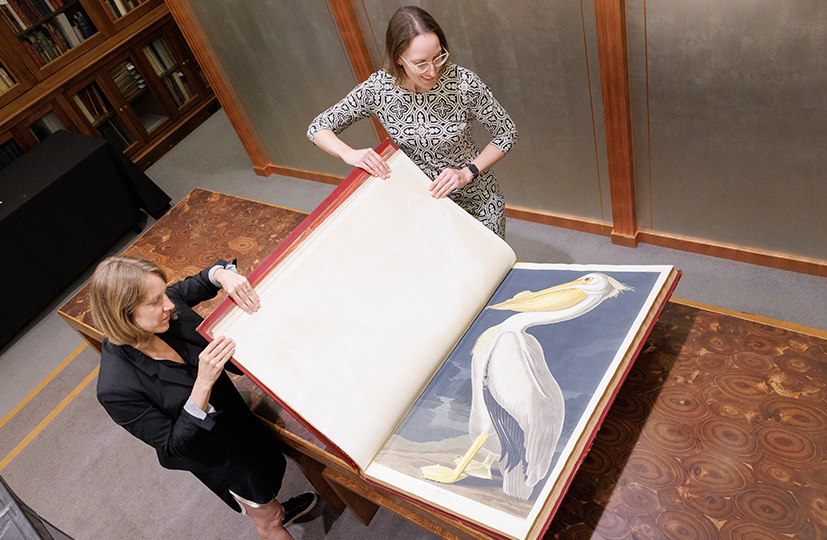

Published between 1827 and 1838, the work was issued as a series of hand-colored engravings, printed on enormous “double elephant” sheets measuring roughly 38 by 26 inches.
Source: Library of Congress
This is a guest post by Ashley Rose Young, a curator in the Rare Book and Special Collections Division. It also appears in the September/October issues of the Library of Congress Magazine.
Cover Photo Caption: Marianna Stell (left) and Ashley Rose Young of the Rare Book and Special Collections Division open a volume of “The Birds of America” by John James Audubon. Photo: Shawn Miller.
In the early 19th century, John James Audubon set out to do something no natural history illustrator had attempted at such scale: depict North American birds at life size, in vivid, animated poses. The result was “The Birds of America,” one of the most ambitious — and physically imposing — sets of books ever produced.
Published between 1827 and 1838, the work was issued as a series of hand-colored engravings, printed on enormous “double elephant” sheets measuring roughly 38 by 26 inches. Audubon partnered with the London engraver Robert Havell Jr. to translate his paintings into prints of remarkable precision and color.
Receive the latest stories in your inbox every day — FREE!
Subscribers received the plates in installments, eventually assembling a collection that included 435 illustrations depicting 489 species of birds. All that paper adds up: Typically bound in four volumes, “The Birds of America” can be astonishingly heavy. The Library’s set totals 196 pounds, with the largest volume weighing a whopping 55 pounds.
Audubon’s commitment to realism extended beyond careful observation. He used wires and pins to stage specimens in dynamic poses, composing scenes that suggest motion and vitality. Wings arc midflight, talons clutch prey and necks twist with startling energy.
That ambition, however, ran up against the limits of even the largest handmade paper available. Some birds simply could not fit on the page without compromise. In his famous depiction of the American flamingo, Audubon bent the bird’s long neck into an elegant but uncanny curve, creating a sinuous composition that feels both graceful and slightly strained.

Audubon’s flamingo became famous in part for how he posed the bird to fit on the page. Rare Book and Special Collections Division.
Other large species are similarly compressed, their bodies contorted to remain within the boundaries of the sheet. These visual negotiations reveal the tension at the heart of “The Birds of America”: a desire to present nature at true scale, constrained by the physical realities of print.
The result is a work that is at once scientifically ambitious, artistically inventive and unmistakably shaped by the medium that made it possible.
You must be logged in to post a comment.