
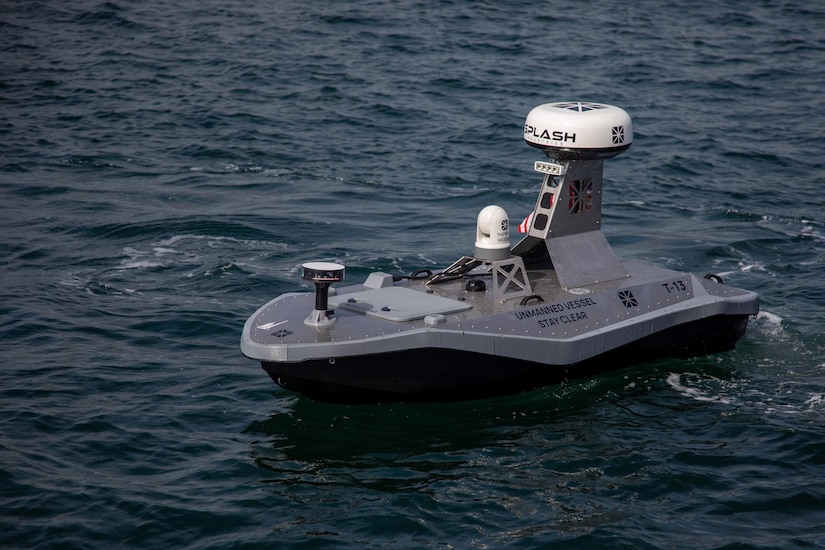
Last month, Secretary of War Pete Hegseth tasked the Agincourt team with two missions: first, stand up a new four-star functional combatant command.
Source: Department of
DefenseWar
By C. Todd Lopez
Photo: Courtesy
In an open letter to industry partners and the joint force this week, Project Agincourt leaders set the tone for how the Autonomous Warfare Command will develop.
Last month, Secretary of War Pete Hegseth tasked the Agincourt team with two missions: first, stand up a new four-star functional combatant command. The Autonomous Warfare Command will lead the joint force in unmanned autonomous warfare.
The second mission: continue the ongoing work of the direct reporting portfolio manager for unmanned systems.
Owen West and Max Strasiser, the chief executive officer and chief operating officer, respectively — both appointed by Hegseth to lead Project Agincourt — discussed their vision, which includes a combat-first model that pushes procurement decisions and dollars directly to frontline warfighters. Success will be measured by how fast an operational problem receives a fielded, scalable solution on the battlefield.
Receive the latest stories in your inbox every day — FREE!
The team also noted that past tools for projecting American military power are no longer sufficient.
“Since the Cold War, American power projection has rested on a small number of sophisticated, expensive weapons,” West and Strasiser wrote. “That model has been disrupted. The U.S. can build a new generational advantage by adapting at the edge faster than adversaries by leveraging two strengths: our lead in super intelligence, and an unmatched [noncommissioned officer] corps.”
The pair also noted that low-cost drones have changed the character, speed and economics of warfare. Hegseth tasked them with ensuring the U.S. keeps pace with adversaries in developing, manufacturing and deploying low-cost autonomous systems.
“Urgency does not excuse imprecision,” they wrote. “We will work analytically with the Joint Staff, the services and, above all, the operational units that will serve as our incubators. Evidence will decide outcomes. Competitions, exercises and combat performance will determine which systems scale, and which are cut.”
West and Strasiser said the “power of the purse” demands strict stewardship, adding that, to flip the cost exchange, every auditable dollar spent should reduce cost or risk.
Autonomous Warfare Command is expected to be operational by Oct. 1, 2027.
“We are on the clock,” West and Strasiser wrote. “In service of Autowarcom, [Project] Agincourt must quickly remove the barriers that constrain the initiative of our service members by fusing operations and development. … If we get this right, we will do more than establish a new command. Autowarcom will institutionalize a mission-based system whose main product is adaptation, building a next-generation development model for sustained American military advantage.”