
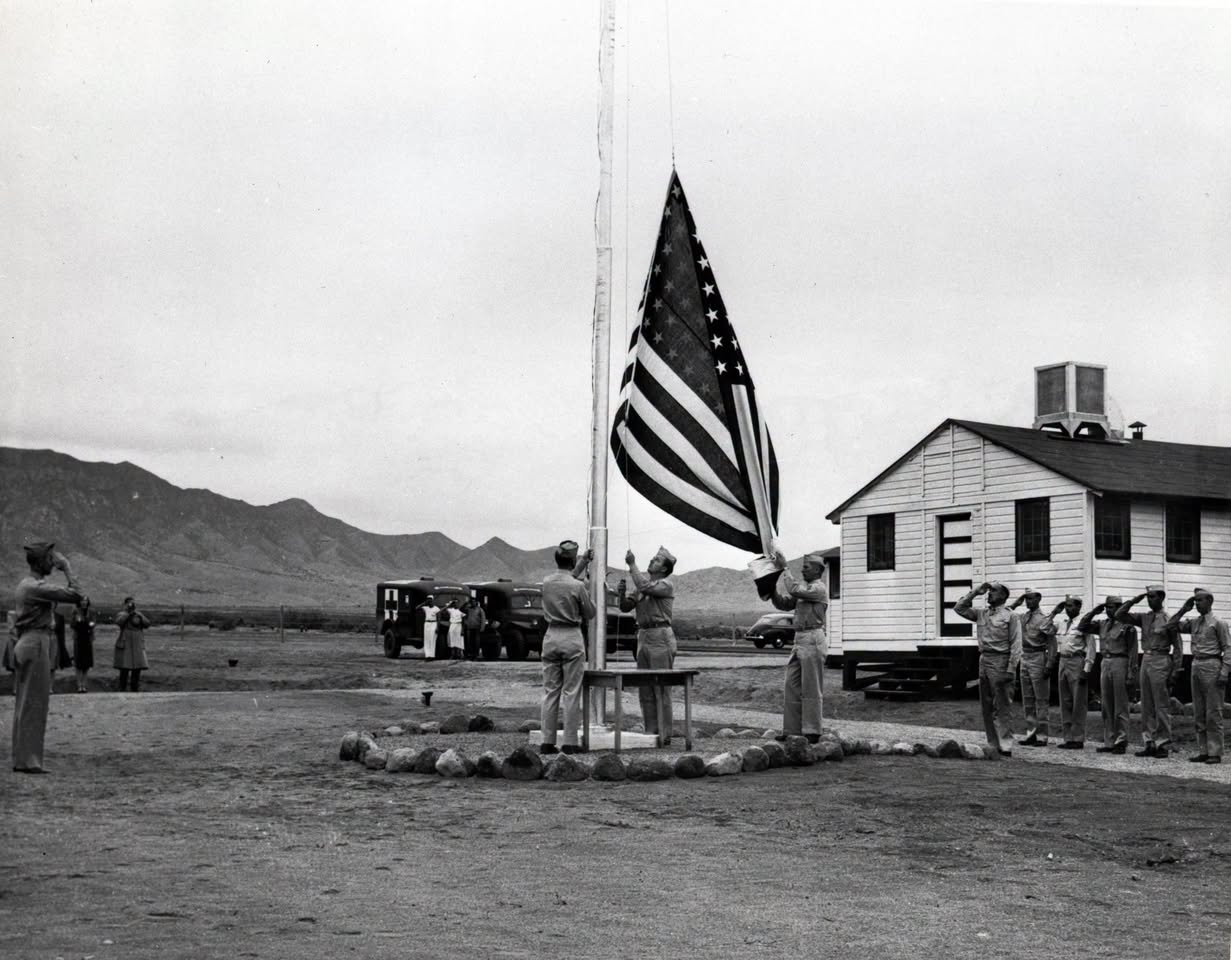

Established in 1933, White Sands National Monument (now White Sands National Park) sat mostly by itself southwest of Alamogordo, NM for almost a decade.
Source: White Sands National Park (via Facebook)
National Park Service and Public Domain Photos: Courtesy
While elite soldiers braved Mount Rainier National Park‘s icy peaks to train for alpine combat, New Mexico’s desert sands were utilized for a different kind of wartime preparation. Just as Washington’s snowy summits tested the infantry, the vast basins of the Southwest would soon test the limits of modern aerial warfare.
Established in 1933, White Sands National Monument (now White Sands National Park) sat mostly by itself southwest of Alamogordo, NM for almost a decade.


That changed on December 14, 1941—just one week after Pearl Harbor—when the Alamogordo Bombing and Gunnery Range (now White Sands Missile Range) was established to the north and west. By February 1942, construction began to the east on the Alamogordo Provisional Bombardment Base, later renamed Alamogordo Army Airfield (AAAF) and known today as Holloman Air Force Base.
The desert landscape of the bombing range provided live-fire target areas for bomber crews to practice precision bombing and aerial gunnery. AAAF served as a crucial training hub for heavy bomber crews conducting final phase training on B-17s, B-24s, and B-29s before deployment to the European and Pacific theaters.
The monument quickly became a recreational escape for thousands of nearby servicemen who flocked here to picnic, hike, and play in the sand. The striking gypsum dunefield served as a popular backdrop for official military photos, unit portraits, and personal snapshots sent to loved ones, while visitors and staff grew accustomed to the roar of heavy bombers overhead. On occasion, the Army would even conduct full-scale maneuvers in the dunes so their truck drivers could gain experience in the difficulties of desert travel.
This wartime emergency forged a strong relationship between the NPS, and the U.S. Armed Forces that has lasted over 80 years. This unique bond continues today, with the park occasionally opening later during WSMR military tests, and visitors still hearing F-16s flying overhead from Holloman AFB.
From desert dunes to the rugged Pacific edge, the next stop is Point Reyes National Seashore on the California coast to discover how its wild beaches transformed into a vital line of defense guarding the West Coast during WWII.
You must be logged in to post a comment.