

Their actions highlighted a capability that can often remain unseen during day-to-day operations along the southern border.
Source: Department of
DefenseWar
By 1st Lt. Daniel Starozytnyk
Photo By Lance Cpl. Preston Morris: Courtesy
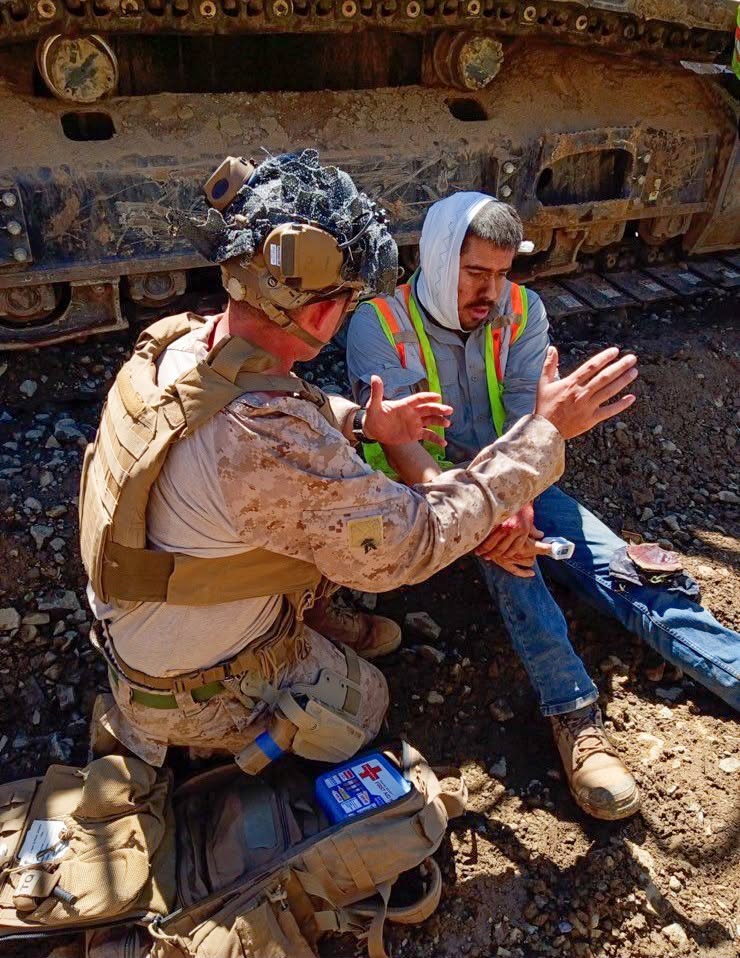
Cover Photo Caption: U.S. Navy Hospital Corpsman 3rd Class Jered Young, a corpsman with 1st Battalion, 2nd Marine Regiment, assigned to Joint Task Force-Southern Border (JTF-SB) in support of Operation Ardent Vanguard renders aid to a construction worker after a vehicle roll-over in Tecante Mountain, California, Oct. 1st, 2026. Young was awarded a certificate of commendation on Oct. 13th for his quick and decisive actions. U.S. Northern Command is working side-by-side with the Department of Homeland Security and the U.S. Customs and Border Protection within narrowly defined authorities to provide unique military capabilities to protect the territorial integrity of the U.S. southern border. (Dept. of War photo by U.S. Marine Corps Lance Cpl. Preston Morris)
TECATE, Calif. – What began as a routine resupply and wellness check for Marines and Sailors operating along the southern border quickly became a race to reach an injured civilian after a vehicle rolled over on the rugged slopes of Tecate Peak, California, Oct. 5, 2026.
Cpl. Edgar Hernandez, Cpl. Rodrigo Loscano and Hospital Corpsman 3rd Class Jared Young, with 1st Battalion, 2nd Marine Regiment, assigned to Joint Task Force-Southern Border (JTF-SB) in support of Operation Ardent Vanguard, changed course and rushed to the scene when a broken radio transmission alerted a vehicle rollover near their position.
The three were traveling toward a remote observation team when the call came across the radio. Because the reported location matched the area where fellow Marines were operating, and communications with the team were temporarily unavailable, they initially feared the worst.
“When you get a call like that, you brace for the worst,” Hernandez said. “Knowing we had a team right at that spot made the initial shock hit hard.”
Receive the latest stories in your inbox every day — FREE!
As they continued toward the summit, updated reports confirmed the Marines were safe, and the rollover involved a civilian construction worker operating near Monument 247 on Tecate Peak.
The change in circumstances did not change their response.
“The human body doesn't change based on a uniform or a job,” Young said.
With no first responders yet at the scene and having a hospital corpsman with them, the team continued toward the accident.
The steep, uneven mountain road eventually became impassable for their vehicle. They dismounted, grabbed their equipment and continued on foot while civilian construction workers directed them toward the injured man.
When they reached the scene, Young found the worker conscious but bleeding heavily from a large laceration on the back of his head.
Young immediately began a trauma assessment and worked to control the bleeding. He packed and dressed the wound before conducting a head-to-toe evaluation of the patient. The worker had also suffered additional injuries consistent with the violent rollover including a possible concussion, a dislocated thumb and significant bruising to his chest and waist.
For Young, there was little time to think about anything beyond treating the person in front of him.
“Absolutely no hesitation - we just went,” Young said. “Nobody ordered us to do it, and nobody asked us to do it. We were simply notified of the incident, recognized we were the closest unit capable of rendering aid, and committed to doing everything we could.”
While Young treated and monitored the worker, Hernandez and Loscano began solving the next problem: how to move the patient off the mountain.
The terrain surrounding the accident site complicated nearly every available evacuation option. Border Patrol emergency medical personnel were still a fair distance away, and Cal Fire ground crews could not reach the casualty's elevation because of the difficult terrain.
Waiting for responders to climb to the accident site could have significantly delayed advanced medical care.
Hernandez and Loscano coordinated with U.S. Border Patrol and Cal Fire to establish an ambulance exchange point farther down the mountain. A construction site supervisor then provided a utility vehicle to help move the injured worker from the accident scene to the Marines' vehicle.
The team loaded the casualty and began transporting him down the mountain.
“At the end of the day, our mission as a CASEVAC platform is to preserve life, whether it's a Marine, a civilian, or a [suspected] illegal alien,” Hernandez said. “The urgency never dropped for a second.”
After navigating down Tecate Peak, the Marines and Sailor reached the designated exchange point where they transferred the patient to Cal Fire and emergency medical personnel. Young provided responders with vital signs, injuries and treatment information before the worker was transported to a hospital for a higher level of medical care.
Once the patient was safely transferred, the team returned to its assigned mission.
Their actions highlighted a capability that can often remain unseen during day-to-day operations along the southern border. In addition to supporting detection and monitoring efforts, service members operating in remote areas maintain the training and readiness necessary to respond when emergencies occur.
For Loscano, however, the decision to help was less about doing something extraordinary and more about living up to the standard expected of Marines and Sailors.
“Honestly, this should be the norm,” Loscano said, following a later recognition ceremony. “This shouldn't be something we hesitate about or question whether we are going to do it. It should just be second nature.”
Lt. Col. Manaois later addressed the Marines and Sailors of the unit, emphasizing that the border mission provides opportunities to make a difference not only through accomplishing assigned operational tasks, but through the impact service members can have on the people around them.
“This mission is about making a difference, and there are a lot of different ways to do it,” Manaois said. “It was someone who needed help, and two Marines and a Sailor stepped up to do their job with the utmost professionalism and proficiency to make a difference.”
The rollover demonstrated how quickly routine operations along the southern border can change and how training, readiness and initiative can become critical when help is far away.
For Young, Hernandez and Loscano, the identity of the person who needed that help was never a factor.
It was simply someone who needed them.
U.S. Northern Command is working side-by-side with the Department of Homeland Security and the U.S. Customs and Border Protection within narrowly defined authorities to provide unique military capabilities to protect the territorial integrity of the U.S. southern border.
You must be logged in to post a comment.