

A Look [magazine] photo essay was a very, very big deal.
Source: Library of Congress
Posted By Neely Tucker
Photos: Courtesy
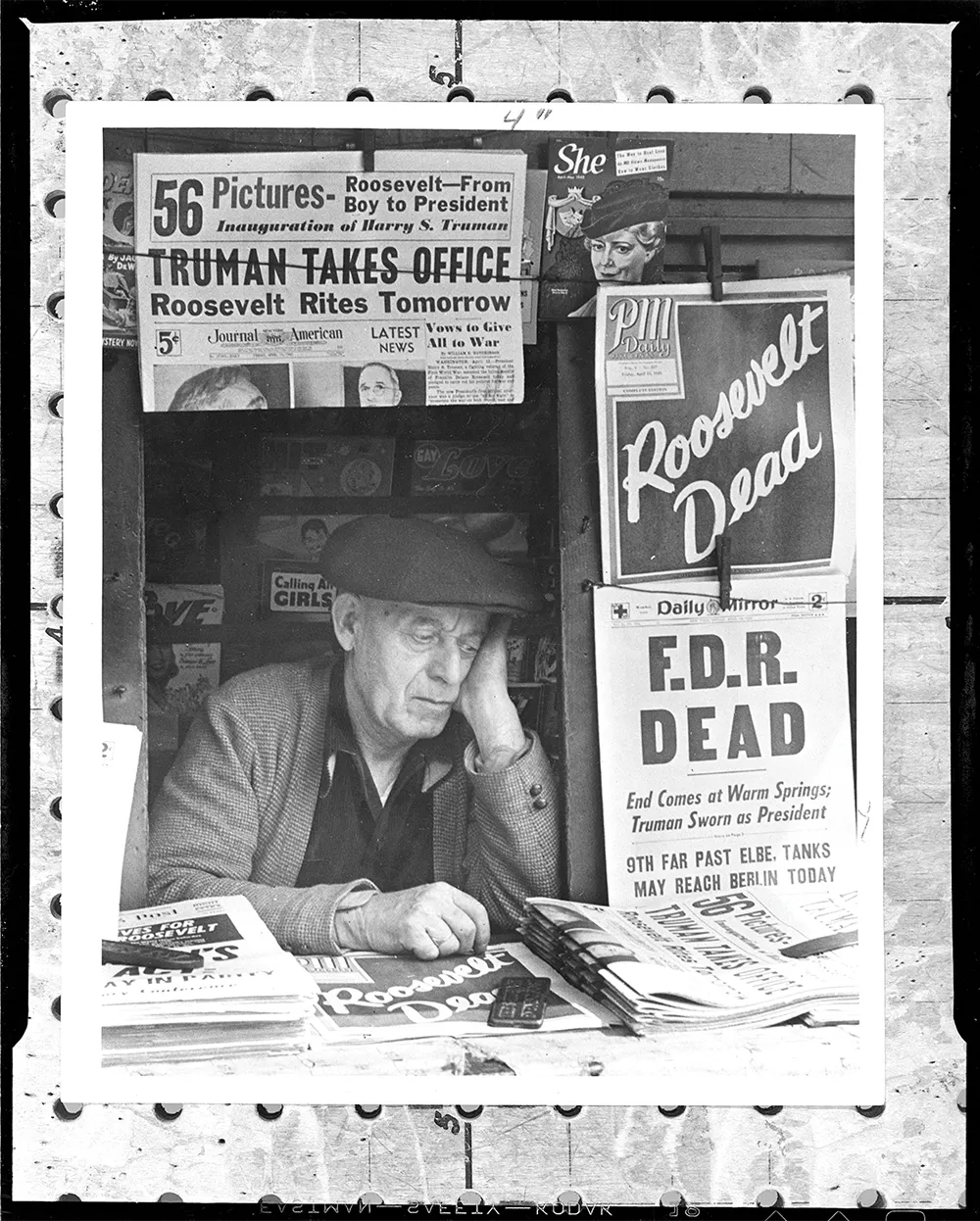
Cover Photo Caption: Stanley Kubrick shot this photo while still in high school and sold it to Look as a freelancer. It ran on June 26, 1945, credited to “Stan Kubrick.” Prints and Photographs Division.
If Stanley Kubrick had not become one of the 20th century’s most influential film directors, there’s no doubt he would have become a highly successful photographer, perhaps even one of the century’s most influential.
This bold assertion doesn’t require much of a leap, since the “Dr. Strangelove,” “2001: A Space Odyssey” and “The Shining” director sold his first photograph to Look (“America’s Family Magazine”) when he was still in high school, was hired as an apprentice at 17 and was already a highly successful staffer at 19.
The work came in place of college training, as Kubrick’s work ethic paid off in the rapid development of style, composition, lighting and a narrative eye. The photo magazine entrusted its teen star to shoot A-list movie stars and complex stories about social issues and sent him on the road to do so. Kubrick’s progression is clear in the 100 story assignments preserved at the Library in the Look Magazine Photograph Collection, with 150 of his images online in the Prints and Photographs Division. (Part of the Look archive is at the Museum of the City of New York.)

Stanley Kubrick playfully sits in on drums (which he played in high school) with members of the George Lewis Ragtime Jazz Band in New Orleans in 1950. Kubrick was photographing the musicians practicing in Lewis’ backyard while on assignment for Look Magazine. Photo: Joseph Roddy. Prints and Photographs Division.
“The photos served as the backbone of Kubrick’s future work,” write biographers Robert P. Kolker and Nathan Abrams in “Kubrick: An Odyssey,” a sprawling 2024 tome that might be the definitive work on their oft-written-about subject.
Kubrick, who died in 1999 at the age of 70, would have agreed with their assessment.
“The experience was invaluable to me,” he later said of his time at Look. “Not only because I learned a lot about photography, but also because it gave me a quick education in how things happened in the real world.”
In all, Kubrick shot more than 25,000 pictures during his 1946-50 tenure, encompassing more than 300 assignments with his images appearing in 135 stories, the biographers write.
The magazine, with editorial offices in New York, was a staple of mainstream America at the midcentury, with a national circulation of around 3 million when Kubrick worked there. That doesn’t give the full picture of the magazine’s cultural impact or how impressive Kubrick’s youthful ascent was — the U.S. population was less than half the size it is today, television was in its infancy and magazines were at their zenith. A Look photo essay was a very, very big deal.

A woman models a dress for a 1949 assignment, “Chicago, City of Contrasts.” Photo: Stanley Kubrick. Prints and Photographs Division.
Plus, Look was founded by media titan Gardner Cowles. The photo director during Kubrick’s tenure was Arthur Rothstein, one of the most influential photographers of the era. And even in Gotham, even on a staff of this pedigree, young Kubrick stood out. By the time he was 19, the magazine was doting on him in print.
“When Stanley joined the staff, his fellow photographers were quick to observe his intense preoccupation with his work,” reads a gushing editorial in the May 11, 1948, edition. “In a spirit of friendly co-operation, they formed a ‘Bringing up Stanley Club’, dedicated to reminding Stanley not to forget his keys, glasses, overshoes and other miscellaneous trivia …”
On top of the “lookit this kid” hype was a prescient observation:
“In his spare time, Stanley experiments with cinematography and dreams of the day when he can make documentary films … photographically, Stanley doesn’t need any help bringing himself up.”
Kubrick was actually brought up in the Bronx, born in 1928 to an affluent Jewish family and in exactly the right time and place to pursue a life as an iconoclastic artist. His parents, Jack and Gert, were college educated, sophisticated and lived in a row house while most everyone else in the area rented an apartment. His father was a doctor, and his wealthy uncles would soon help bankroll some of his early films.

Former middleweight champion Rocky Graziano, 1949. Photo: Stanley Kubrick. Prints and Photographs Division.
Antisemitism was common in much of the nation at the time, but the Bronx was almost 50% Jewish and produced a sea of influential writers, actors and performers. Kubrick’s Bronx contemporaries were people such as Calvin Klein, Carl Reiner and E.L. Doctorow. Eydie Gormé, the singer and actress (famously married to her musical partner, Steve Lawrence), sang in the high school band in which Kubrick played drums.
Young Stanley was certainly not a prodigy in the classroom. He graduated high school with a 70.1 average and no real chance of getting into college. But with his initial salary at Look of $50 per week (the equivalent of about $48,000 per year today), he and his first wife, Toba Metz, soon settled into Greenwich Village society, a hotbed of avant-garde artists.
After a few years, though, he had outgrown the magazine. He quit in July 1950. He was 21, had just completed a documentary short and was ready to wade into feature films.
“It was tremendous fun for me at that age,” he later wrote of his time at Look, “but eventually it began to wear thin, especially since my ultimate ambition had always been to make movies.”
You must be logged in to post a comment.