

Robert R. Newlen, the acting Librarian of Congress, writes in the exhibit’s companion book that “Voices” is designed to “spark conversations among the creators of these works, the sources they cited, the ideas they explored, the communities that continue to tell their stories today, and, importantly, our visitors and researchers.”
Source: Library of Congress
Posted By Neely Tucker
Images: Courtesy
The early Americas: jade pendants, the infant Jaguar god of the Underworld, empires, gold, silver, gods, art, books, temples, pyramids, Incas, Aztecs, Olmecs, Mayas, Taínos, Nahuas, maps, pictograms, Spanish, Portuguese, French, British, Dutch, Africans and vast new nations.
This is but a smattering of “Voices of the Early Americas,” the Library’s new permanent gallery in the Jefferson Building that draws heavily on the Jay I. Kislak Collection of the Archaeology and History of the Early Americas and is complemented by other rare books, maps, photographs and modern poetry from across the Library.

The new gallery, primarily funded by the Kislak Family Foundation, is divided into four periods and in roughly chronological order. It expands and deepens an earlier Kislak exhibit and tells a more far-ranging narrative from roughly 3,000 years ago into the 21st century. Display screens stretch high overhead; an artifact wall shows many objects for the first time; and high-tech displays turn a sweeping history into an immersive experience.
“In many respects, it’s a story that only the Library can tell,” says Matthew Robb, the Mesoamerican specialist in the Latin American, Caribbean, and European Division. “Only the Library has this kind of scope and scale of material from across all its divisions across all these eras.”
Robert R. Newlen, the acting Librarian of Congress, writes in the exhibit’s companion book that “Voices” is designed to “spark conversations among the creators of these works, the sources they cited, the ideas they explored, the communities that continue to tell their stories today, and, importantly, our visitors and researchers.”
Kislak, a New Jersey- and later Florida-based real-estate magnate and philanthropist, assembled his collection over five decades and first donated nearly 3,000 items to the Library in 2004. His collections — artifacts, documents, paintings, maps, charts, rare books, manuscripts — represented more than a dozen Indigenous cultures from Mexico, the Caribbean and Central and South America.


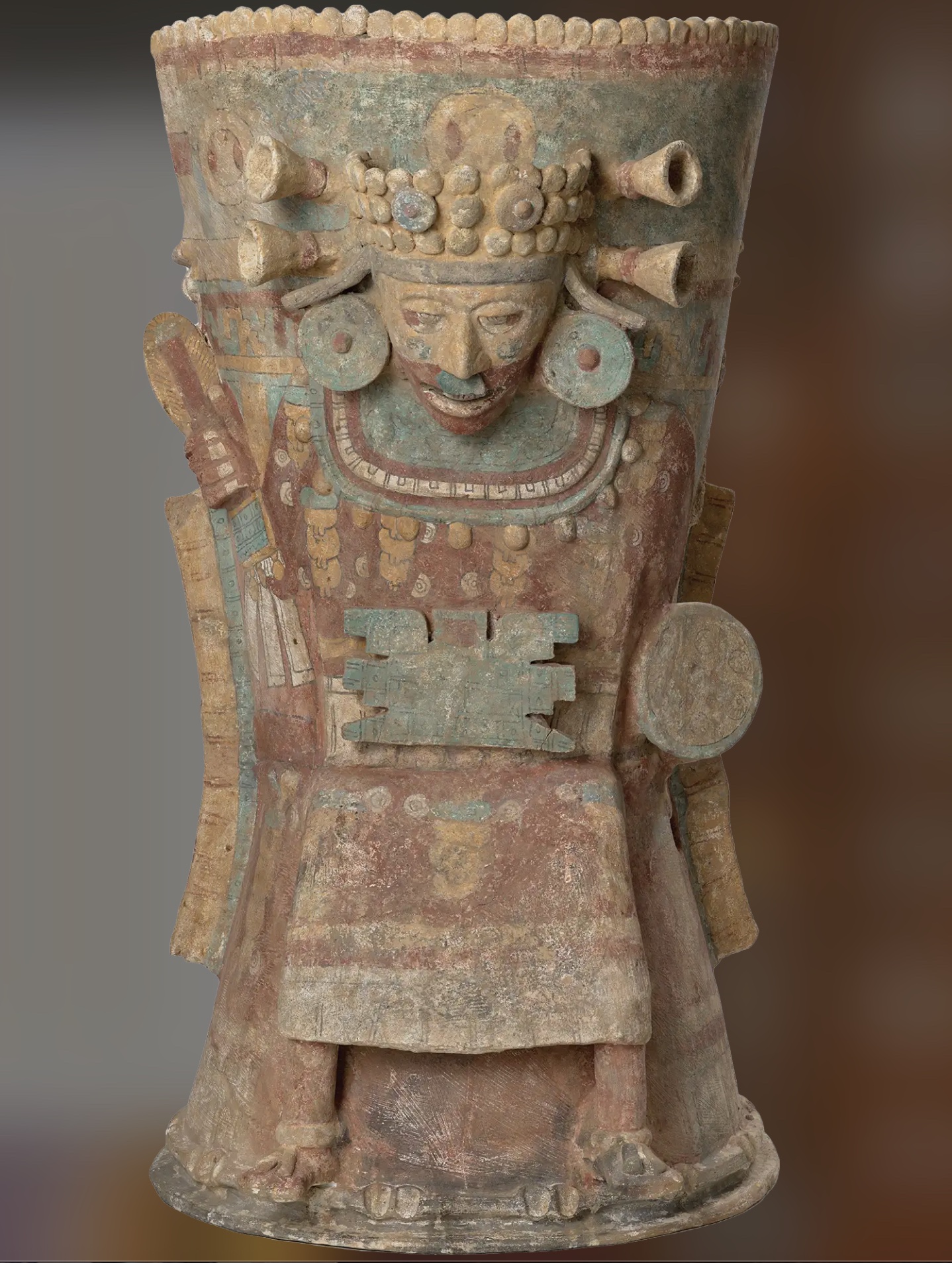
(Left) Zapotec effigy urn made circa 500-600 in Oaxaca, Mexico. Rare Book and Special Collections Division; (Middle) A gold breastplate fashioned by a Coclé metalsmith some 1,200 years ago in present-day Panama. Rare Book and Special Collections Division; (Right) An Aztec incense burner in the form of a warrior, 1400-1500. Rare Book and Special Collections Division. (Photos: Collections Digitization Division.)
The post-contact world is a major part of his collection and the new gallery as well, with handwritten documents from King Philip II of Spain and Francisco Pizarro. Kislak also documented Colonial America, and his collection includes the 1762 diary of George Washington and correspondence from Thomas Jefferson and John Quincy Adams.
Taken together, the new gallery “reminds us that the cultural and political foundations of the Americas grew not from a single colonial origin, but from a complex convergence of peoples, empires, and worldviews,” as the companion book’s opening essay has it. The gallery “… helps reposition the history of what became the United States within a much deeper and more entangled hemispheric story.”

The Tortuguero Box, a rare wooden Maya artifact, dates to A.D. 681. Jay I. Kislak Collection. Photo: Collections Digitization Division.
It’s this specificity, accentuated by the passing centuries of time, that gives this tiny bit of sapodilla wood, decorated with red hematite and containing a greenstone figure inside, its power. This is not an anonymous well-done carving, but the name, date and title of a very real person who once held it in his hand on a specific day in a specific place 1,345 years ago. It centers us in his world, if only for a flicker.
Then there’s the broad, intercultural stories that span decades and centuries. Visitors can compare the Taíno exhibits, which document life in the Caribbean, with roughly contemporaneous material from Aztecs and other societies in modern Mexico.
“What are these civilizations like in which people in Tenochtitlan are in touch with people on the Gulf Coast?” Robb says. “And those folks on the Gulf Coast — Veracruz, Tabasco, what’s now the Yucatán — they’re in touch with people in the Caribbean. There’s a lot of trade, cultural exchange and some conflict.”
Receive the latest stories in your inbox every day — FREE!
The visual core of the exhibit is eight huge “Conquest of Mexico” paintings, depicting (in highly idealized terms) the Spanish conquest of the region. Europeans took those paintings, by an unknown artist, and other similar narratives as historic guideposts and shaped their histories accordingly.
But here, alongside the paintings, are digital presentations of Indigenous accounts of the conquest. These are the stories of the people who survived it, the Nahua, whose most famous members are the Aztecs.
“This is the story that was being written in Tenochtitlan and in Tlatelolco (both covered by today’s Mexico City) in the 1550s and the 1560s,” Robb says. “This is the local history.”
Not surprisingly, those are not the same stories.
The Indigenous accounts stem from a massive 16th-century manuscript, today known as the Florentine Codex, that was created by Franciscan friar Bernardino de Sahagún and several Nahua elders from across the community. It was composed with parallel text, in Nahuatl and Spanish, and contains more than 2,500 images and 12 books that detail Nahua history, society and culture.
The final book tells the story of the Spanish conquest of Mexico, with myriad details that were unknown to the conquistadors and certainly not represented in the high-glory style of the paintings.

Spanish forces lay siege to Tenochtitlan in this late 17th-century painting by an unknown artist. Rare Book and Special Collections Division. Photo: Collections Digitization Division.
“… those who were conquered found out and gave account of many things that happened among them during the war, things that those who conquered did not know,” Sahagún wrote.
One important detail: Though the Spanish, and sometimes even the Nahua, referred to the conquistadors as “soldiers,” and they were immortalized in the paintings that way, they were actually a far grungier lot.
“They were not soldiers as in trained military specialists, representatives of the Spanish crown as an army,” Robb said. “They were expeditioners. They were travelers, they were entrepreneurs, they were the second and the third sons of semi-important families in Spain. … There is this discrepancy when you start understanding just how kind of ragtag those guys actually were in comparison to how you see them presented later on in these paintings.”
All this can get to be almost overwhelming, of course.
So, it’s a good idea to rest for a moment and gaze down at a particular tiny ceramic male figurine. He is seated, shirtless, bald, legs crossed, cream colored. His creation is attributed to the Olmecs in Mexico somewhere around 3,000 years ago. There’s a splash of red around the lips, nose and chin. The arched eyes are squinting back at you, perhaps closed altogether.
And by some small miracle this figurine has survived from all that time to this, small and still, never once getting left behind or broken or cracked but preserved by so many hands in so many times and places and now it rests in front of you, a talisman from a world we can scarcely imagine.
On what day was it made, by whom and for what? And how does it tie in so neatly with one of the most modern parts of the exhibit, this poem by Natalio Hernández? Born in 1947 in Mexico, Hernández wrote it in Nahuatl, one of the ancient languages of the region, and its sentiments could well have been those of the artisan who shaped this figurine now in front of you:
I will live an entire century;
I will live many centuries.I will savor each word
and every single flower
I will relish each sunrise, each sunset.I will work thinking of today,
of tomorrow and the day after tomorrow;
I will carve a path, my path, my destiny.

A jade pendant, a codex-style ceramic vessel and a French translation of a Spanish work on Mayan hieroglyphic writing. Rare Book and Special Collections Division. Photos: Collections Digitization Division.
You must be logged in to post a comment.