
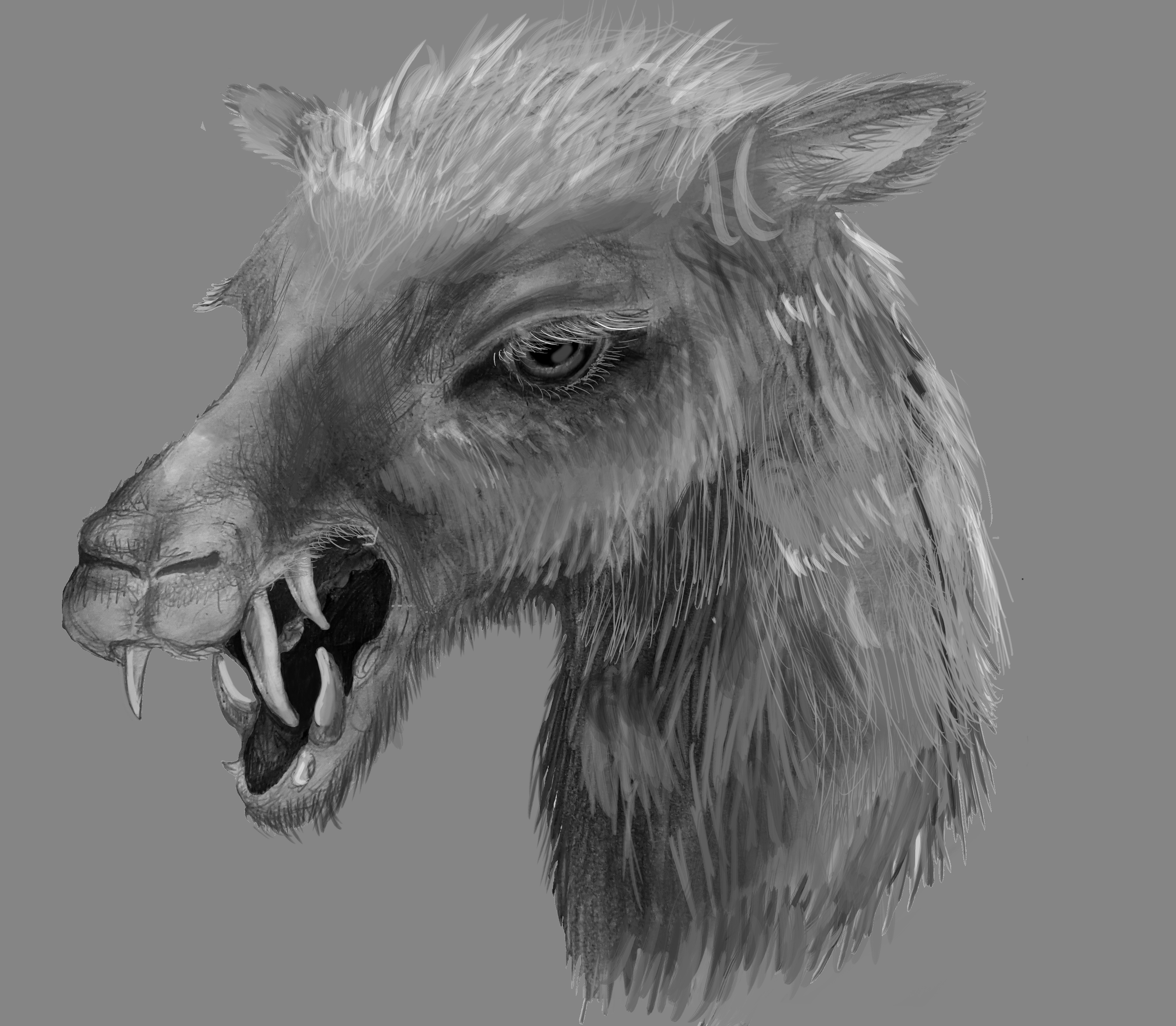

The research team that identified the new species, known as Vampyrocamelus welshi, included New Mexico Museum of Natural History & Science Education Director Stephanie Lukowski, who studies ancient camels and other prehistoric mammals.
Source: New Mexico Museum of Natural History and Science
Cover Image: A rendering of Vampyrocamelus welshi, by Kate Marriott.
Albuquerque, NM – Move over, Dracula: a new species of prehistoric ‘vampire’ camel known for its massive fang-like teeth has been identified from research just published in the New Mexico Museum of Natural History & Science Bulletin.
The research team that identified the new species, known as Vampyrocamelus welshi, included New Mexico Museum of Natural History & Science Education Director Stephanie Lukowski, who studies ancient camels and other prehistoric mammals. This research was part of a recent New Mexico Museum of Natural History & Science Bulletin, a multi-chapter monograph, helmed by lead author Donald Prothero, that documents and revises research on prehistoric camels, the largest project of its kind since the nineteenth century.
“Vampyrocamelus was just one of many unique species of camels that lived in North America millions of years ago,” Lukowski said. “This research not only helps us better understand the remarkable diversity of prehistoric camels in North America, but it also highlights the value of museum collections, which make work like this possible.”
Receive the latest stories in your inbox every day — FREE!
Vampyrocamelus was a tall, giraffe-like animal that lived 9 to 12 million years ago in what is now Oklahoma and the Texas Panhandle. While fossils from the species have not yet been uncovered in New Mexico, Lukowski noted that rocks from the same age are present in Northern New Mexico, suggesting that it was possible the species could have lived in the area. A number of prehistoric camel species have been found in 15-million-year-old rocks near Española.
Vampyrocamelus is distinguished from other prehistoric camel species due to the unusually large, recurved canines found in male skulls. Those fang-like canines, reminiscent of those from mythical vampires, form the basis of the name. Researchers believe that the oversized teeth weren’t used for hunting or eating, but rather to defend against predators and impress potential mates.
Camelidae, a family of mammals that includes camels, llamas, and alpacas, originated in North America around 45 million years ago, and a wide variety of camel species – from small, agile mammals to rhinoceros-sized Megacamelus – proliferated on the continent. Despite the robust fossil record in New Mexico and elsewhere, however, there has been no comprehensive review of this family of animals since 1898.
To better understand prehistoric camels, Lukowski and other researchers combed through the American Museum of Natural History’s Frick Collection in New York City, the largest collection of prehistoric camel fossils, measuring skulls, limbs, and other bones to review and update the systematics of all the North American Camelidae. The full monograph, titled “The Evolution of North American Camels,” is available to download here.
About the New Mexico Museum of Natural History and ScienceThe New Mexico Museum of Natural History and Science is a division of the Department of Cultural Affairs, under the leadership of the Board of Trustees of the New Mexico Museum of Natural History & Science. Programs and exhibits are generously supported by the New Mexico Museum of Natural History Foundation, through the generous support of donors. Established in 1986, the mission of the New Mexico Museum of Natural History & Science is to preserve and interpret the distinctive natural and scientific heritage of our state through extraordinary collections, research, exhibits, and programs designed to ignite a passion for lifelong learning. The NMMNHS offers exhibitions, programs, and workshops in Geoscience, including Paleontology and Mineralogy, Bioscience, and Space Science. It is the Southwest’s largest repository for fossils and includes a Planetarium and a large format 3D DynaTheater.
You must be logged in to post a comment.