
The Thunderbirds perform for people all around the world to display the pride, precision, and professionalism the U.S. Air Force represents.
Source: White Sands Missile Range (via Facebook), Department of
DefenseWar
Photos: Courtesy
The White Sands Missile Range Command Team, including Col. Andrew Morgan and Command Sgt. Maj. Hermes Acevedo took a tour of Holloman Air Force Base and met with the 49th Wing leadership for a mission briefing and an overview of the base’s training missions involving the F-16 fighter jet and the MQ-9 remotely piloted aircraft.


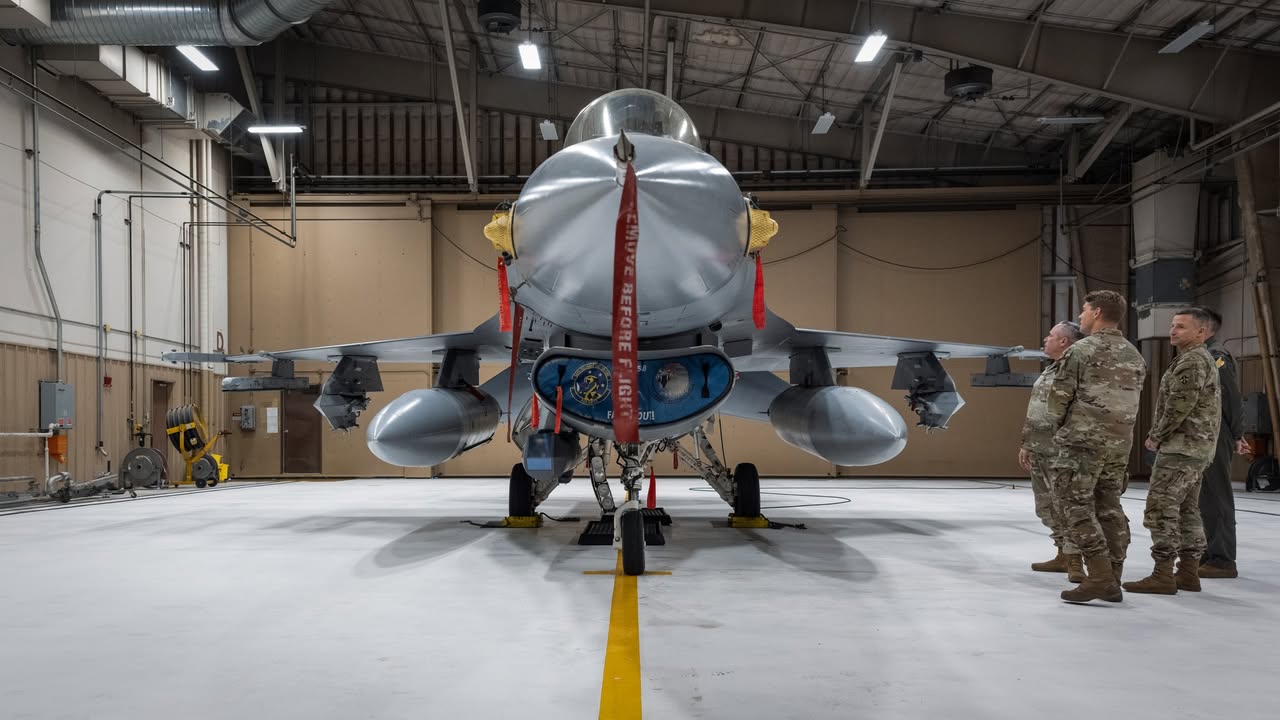
They visited a ground control station where they simulated flying an MQ-9 Reaper and viewed an F-16 Fighting Falcon on display at the 311th Fighter Squadron. The Command Team also toured the facilities at the 704th Test Group.

On 16 January 2026, White Sands Missile Range Senior Commander, COL Andrew Morgan, and White Sands Missile Range CSM Hermes Acevedo met with Lt. Col. Alexander “Knight” Prevenda and the visiting Air Force Thunderbirds as part of their winter training at SpacePort America, New Mexico. The Thunderbirds perform for people all around the world to display the pride, precision, and professionalism the U.S. Air Force represents.


According to United States Air Force Demonstration Squadron Public Affairs, Winter training involves the full-scale deployment of roughly 70 team members, nine F-16’s, and equipment across three locations: Spaceport America, New Mexico; Edwards Air Force Base in California; and Naval Air Facility El Centro, California, to hone performance skills in diverse conditions before the show season.
Throughout winter training, the team progresses through a deliberate training syllabus, regularly flying twice a day to meet objectives. The team also conducts required jet maintenance, practices the ground ceremony, and rehearses show-center operations such as narration, music, filming, and safety observing. The Thunderbirds are slated to perform over 60 demonstrations across the nation throughout 2026, marking the 73rd year that the team will represent the U.S. Air Force.
Air Force F-35As Deliver Deterrence at Altitude
By Air Force Airman 1st Class Arnet Tamayo, 353rd Special Operations Wing
The runway trembles as Air Force F-35A Lightning IIs surge forward, heat waves dancing behind their engines. The low growl builds to a thunder, echoing across the skies of the Pacific Ocean.

At the heart of that power is the 356th Expeditionary Fighter Squadron, deployed from Eielson Air Force Base, Alaska, to Kadena Air Base, Japan, as part of the Air Force’s fighter rotation program, and prepared to safeguard the skies whenever a mission calls.
“Our mission is to ensure air dominance whenever and wherever we’re called,” said Air Force Maj. John Toner, deployed director of operations for the fighter squadron. “Every training event and every sortie strengthens our ability to deliver combat airpower and ensure stability across the Pacific.”
However, that readiness isn’t developed overnight.
The squadron regularly integrates with F-35B Lightning II aircraft from Marine Corps Air Station Iwakuni, Japan, refining the ability to generate combat airpower from alternate locations. The squadron also participates in large-scale exercises like Keen Sword, reinforcing interoperability and strengthening the U.S.–Japan alliance across the Indo-Pacific region.
Working alongside E-3 Sentry aircraft from the 961st Airborne Air Control Squadron adds a vital layer of airborne command and control, synchronizing missions across air, land and sea domains. Large-force exercises unite U.S. and Japan Air Self-Defense Force aircraft in coordinated formations, transforming partnership into combat-ready power.
“We’re getting on the same sheet of music and operating at a common level ,” said Air Force Capt. Ryan Beveridge, squadron fighter pilot. “Integrating with our allied partners out here has been invaluable. That kind of trust and understanding is what makes deterrence real.”
Behind every launch are the airmen of the 18th Wing, whose infrastructure and support ensure that rotating units like the 356th EFS can arrive and be airborne almost immediately, maintaining a seamless and persistent presence in the region.
As part of the Pacific Air Forces, the fighter squadron brings the unmatched capabilities of the F-35A: a fifth-generation fighter designed for dominance in contested environments. Its stealth profile, sensor fusion and advanced electronic warfare systems connect every platform on the battlefield, allowing pilots to see farther, decide faster and act decisively.
“The F-35 gives us an edge that extends beyond the jet itself,” Toner said. “It’s a force multiplier that links our forces, amplifying deterrence across the theater.”
Operating from Eielson, just south of the Arctic Circle, the 356th trains year-round in some of the harshest conditions on Earth. That experience builds resilience and adaptability, skills that translate directly to deployed operations. The proximity between Alaska and Okinawa allows the squadron to rapidly deploy and sustain missions anywhere in the Pacific.
“Deterrence at altitude is built on preparation,” Beveridge said. “Every sortie we fly and every partner we train with ensures our allies know we’re ready and our adversaries know we’re capable.”
From Alaska’s icy ranges to Okinawa’s tropical skies, the 356th Expeditionary Fighter Squadron stands as a symbol of American airpower and commitment that is ready, resilient and relentless in safeguarding peace across the Indo-Pacific.
You must be logged in to post a comment.