
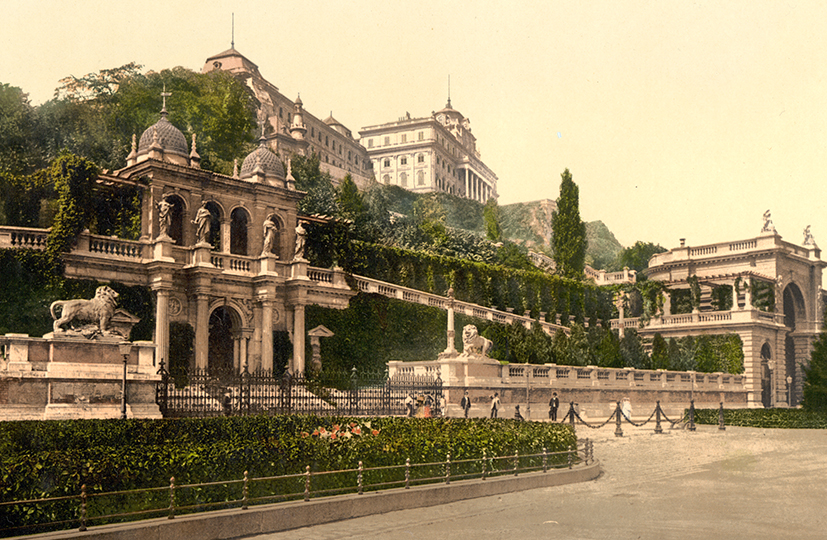
Director Wes Anderson, a staunch supporter of the work of Library’s National Film Preservation Board, made extensive use of the Library’s photochrom print collection of Eastern European locations in designing the film’s titular hotel.
Source: Library of Congress
Posted by: Neely Tucker
Images: Courtesy
Cover Image Caption: A photochrom print of the Buda Castle in Budapest, Hungary, made during 1890-1900. Photo: Unknown. Photographs and Prints Division.
Eastern European high society was teetering on its aging high heels in the 1930s, a world of royalty, empire and inherited wealth that had been weakened by World War I and was about to be obliterated by World War II.
So of course film director Wes Anderson saw the comic possibilities.
“The Grand Budapest Hotel,” his 2014 film just inducted into the National Film Registry, is a bittersweet comedy told in his instantly identifiable style. Set in a fictional Eastern European country in the 1930s, there are quirky characters, dollhouse-style sets and comedy that ranges from deadpan to slapstick. But because it’s set against the very real backdrop of the impending war, it carries an emotional depth that lingers.
Anderson, a staunch supporter of the work of Library’s National Film Preservation Board, made extensive use of the Library’s photochrom print collection of Eastern European locations in designing the film’s titular hotel.
“We’d written a story and when we started saying, ‘Well, what is it like?’” Anderson said in an interview with the Library, “the architecture and the landscapes that we were looking for, they don’t exist anymore …. much of what is in our film comes directly – with our little twist on it – from that collection, from the Library of Congress.”
Photochroms were postcard-like prints, created in the late 1880s, that were usually of landscapes and historic sites. A single black-and-white glass negative was put through a chemical process, with the image transferred to a printing surface where color was added using as many as 6 to 10 separately inked stones. Thousands of impressions were then printed. The result was colorized images before color photography.

Ralph Fiennes (l) and Tony Revolori (r), starred in “The Grand Budapest Hotel.” Photo courtesy of American Empirical Pictures.
They were popular in Europe and, in the U.S., through the Detroit Publishing Company. The fad largely came to an end after World War I.
Anderson’s team focused on more than 6,000 European images in a collection the Library purchased in 1985 from the Galerie Muriset in Switzerland. The film crew also toured hotels and resorts of the era that were still operating.
Receive the latest stories in your inbox every day — FREE!
For the atmosphere, Anderson turned to the work of Austrian writer Stefan Zweig. A cultured native of Vienna, born in 1881 during the height of the Austro-Hungarian Empire, Zweig was a very popular and influential writer during the 1920s and early1930s.
He was also Jewish and a pacifist. He fled the country in 1934, eventually settling in Brazil. He mourned the lost world and culture of his homeland destroyed by the Nazis, particularly in his final work, a 1942 memoir entitled “The World of Yesterday: Memories of a European.”
He mailed the manuscript to his agent in February 1942, while World War II raged. The next day, he and his wife, Lotte Altmann, committed suicide by taking an overdose of barbiturates.
Anderson was so influenced by Zweig’s work that he gave him a co-writing credit on the film.
Anderson also paid tribute to the Library’s film preservation work, explaining that films from bygone decades are inherently documentaries, showing the way the world once was. “Grand Hotel,” which won the Academy Award for Best Picture in 1932 (and is also in the NFR), was another invaluable window into the era.
“It’s how they lived then, the things they’re taking for granted about life that you automatically would know then, and that now we seem exotic,” Anderson said. “The life of the hotel partly comes from that.”
You must be logged in to post a comment.