
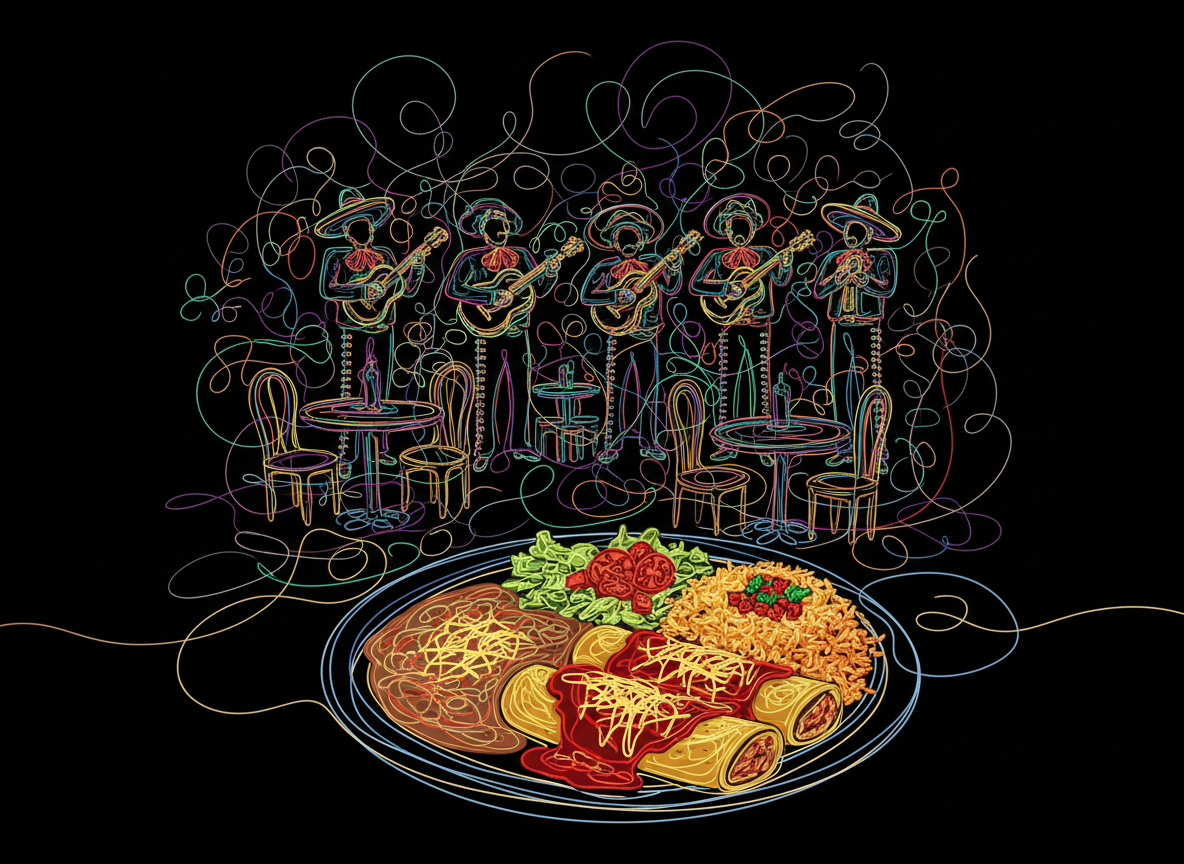
Before asking what makes a combination plate great, it helps to ask a larger question: what makes any dish great?
By Levi Gwaltney
Photo of Gordon Ramsay Courtesy U.S. Army
When Gordon Ramsay came to Mesilla in 2014, the buzz across our broader community was easy to understand.

This was not just another television chef passing through southern New Mexico. This was Gordon Ramsay — the celebrity face of elite dining, the kind of chef whose approval is treated by many as a kind of culinary coronation. For a moment, it seemed possible that the food locals had known and defended for generations might finally be recognized on a larger stage.
But Ramsay had come to film Hotel Hell at Meson de Mesilla, and the episode focused on a struggling hotel, a mismatched Tuscan identity, management problems, and an owner more interested in singing to guests than running the property. The intervention was largely about operations, redesign, and rebranding, not the cuisine that has actually defined this region for generations.
Locals noticed.
The disappointment was not really about television. It was about recognition. People in our broader community already knew something the episode never bothered to discover: the best food here had never depended on celebrity approval. It did not need imported prestige. It was already exceptional, and exceptional in a way that money could not easily improve.
That is where Combination Plate #2 enters the conversation.
Before asking what makes a combination plate great, it helps to ask a larger question: what makes any dish great?
In most restaurant traditions, greatness tends to gather around a singular plate. One dish becomes the peak expression of a category, and over time that dish often becomes more expensive, more theatrical, and more exclusive. Beef Wellington is one of the clearest modern examples. It is not merely beef in pastry. It is a statement dish, a restaurant dish, a plate whose prestige is tied to labor, presentation, and price. On a current Gordon Ramsay menu, the full Beef Wellington is listed at $74.
That is how a great dish usually behaves. Its price rises with its stature. Its exclusivity becomes part of the story.
Combination Plate #2 takes the opposite path.
Its greatness does not depend on rarity. It does not depend on luxury. And it certainly does not depend on becoming more expensive every year in order to remain respectable. Its greatness depends on its ability to stay great while resisting upward price pressure.
That is not because it is cheap — not because it is lesser. Combination Plate #2 was never peasant food. It has always been elevated, even when its pricing failed to reflect that elevation. What makes it remarkable is that it is not a singular dish at all. It is a plate made from several superlative things at once, and each of those things contains room for variation without surrendering the identity of the whole.
That is why it lasts.
The enchilada is the obvious place to begin, because without an enchilada there is no respectable Combination Plate #2 in our broader community. The enchilada is not one optional component among many. It is the anchor. But even the anchor contains choices. A diner may favor red or green — rolled or stacked, pancake-style. A kitchen may lean one way or the other, and still the enchilada remains fixed in role and flexible in expression.

The same is true of the rest of the plate. Beans may be whole or refried. The fresh component may be a little salad, a cabbage slaw, lettuce and tomato, or some older trace of service, like a parsley garnish trying its best to dignify the edge of the plate. Rice may be mild and tomato-forward or more assertively seasoned. What local kitchens generally call Spanish rice clearly descends from the same broad stream of Iberian cooking that gave the world paella, but it is no paella. It lacks saffron’s perfume and color, and for good reason. In local food, spice does not merely tint the dish. Chile becomes the central ingredient, the thing that builds the plate from the inside out rather than decorating it from above. That distinction remains relevant enough today that New Mexico State researchers are actively exploring saffron as a possible local crop. (See: “Share Cropping: NMSU research project explores intercropping of saffron, other NM crops.”)
Then comes the restaurant flourish.
A relleno. A tamale. A taco. A burrito bañado. A bowl of red chile.
This is where the plate stops being a familiar enchilada dinner and starts becoming restaurant food. Combination Plate #1 often announced a kitchen’s signature. It said: here is the standard plate, and here is the one extra thing this kitchen does especially well.
Combination Plate #2 went further. Sometimes it contained everything on Combination Plate #1 and then added another item. Sometimes it simply grew in another direction. Either way, it became the first plate designed fully for the diner rather than inherited directly from the home table. It was no longer just a restaurant serving what people already knew. It was a restaurant composing something that could not reasonably have been expected from abuela’s kitchen — not because she lacked skill, but because the labor, cost, and purpose of a home meal were different.
That is the hidden elegance of Combination Plate #2. It composes abundance without tipping into excess.
Local menus still tell that story. At La Posta de Mesilla, Combination Plate #2 brings together a rolled red or green enchilada, red chile con carne, two rolled tacos, frijoles, rice, and Mexican slaw. At Nopalito’s, Combination Number Two adds a red tamal to a plate already carrying taco, flauta, rolled enchilada, chile con carne, beans, and rice. At ¡Andele!, Number 2 (Rojo) includes a rolled red enchilada, pork tamale, chicken flauta, red chile con carne with potatoes, beans, and rice. The showpiece changes. The plate grows. But the enchiladas that anchor the plate remain, and they are always accompanied by beans.
Beans are not what the kitchen adds when it runs out of imagination. They have been there all along, unceremoniously making the transition from abuela’s back burner to one of humanity’s great plates. Beans ground the dish in the traditional, drawing a straight line from restaurant directly back to the home kitchen.
Perhaps that is one reason Ramsay never really saw what was in front of him when he came through Mesilla. A food culture that takes beans seriously does not always read as elevated to a culinary world trained to associate luxury with cost. But that failure says more about the observer than the ingredient.
New Mexico State University’s Cooperative Extension Service still treats pinto beans the way our broader community long has: as a staple worthy of instruction, not apology, emphasizing their nutritional value and their natural partnership with rice or corn. And outside New Mexico, no one feels compelled to apologize for beans when they anchor a canonical French cassoulet.
Basic Back Burner Beans
Courtesy: NMSU Cooperative Extension
Dry beans can be cooked quickly in a pressure cooker or microwave oven, or they can be cooked slowly in a crockpot or a saucepan on the stovetop.
Sort the beans to remove small stones, lumps of dirt, and damaged or defective beans. Wash the beans with several changes of water until the water runs clear.
Soak beans to reduce cooking time, using 5 cups of hot water for each cup of beans. For a quick soak, add beans to water in a saucepan and bring to a boil for 2 minutes. Remove from heat, cover, and let stand for one hour. For overnight soaking, cover beans with cold water and refrigerate.
Discard soaking water, replace with fresh water, and cook the beans in one of the following ways. (Note: When cooking in the microwave, on the stovetop, or in a crockpot, never fill the pan more than half full.)
Stovetop saucepan: Cover soaked, rinsed beans with fresh water and bring to a rapid boil, then reduce heat to simmer. Cover and cook until tender, but not mushy. Add water if necessary. Total cooking time will depend on water hardness and altitude, usually 2–3 hours.
Tips For Success
- To prevent skins from bursting, simmer gently and stir as little as possible.
- Increase cooking time in high altitude and/or hard water areas
- Cook the full contents of smaller packages of beans, such as the 1-pound size
- Refrigerate leftover cooked beans; drain cooked or canned beans before freezing.
- Store dry beans in airtight glass or metal containers in a cool place
- Add 1/8 to 1/4 teaspoon of baking soda per cup of beans to shorten cooking time in hard water, or use distilled water. Excess soda will cause an undesirable flavor and loss of nutrients
- A teaspoon of sugar and a clove of garlic enhance the flavor of plain, cooked pinto beans.
- If a recipe calls for tomatoes, lemon juice, wine, or vinegar, add when beans are almost tender. Acid delays softening and increases cooking time.
- A 1-pound package of dry beans is equivalent to 2 cups dry or 5–6 cups cooked beans.
NMSU photo by Susan B. Portillo: Courtesy
So the rule ought to be simple enough:
Those who minimize legumes in fine cuisine don’t know beans about great plates.
This is where Combination Plate #2 separates itself from a singular elite dish like Beef Wellington.
A singular dish is chained to a singular identity. Once its defining ingredient becomes too costly, its greatness becomes harder to access. Combination Plate #2 survives upward price pressure precisely because it was never chained to a single premium ingredient in the first place.
Its fungibility protects its greatness.
And its fungibility protects its affordability.
If beef rises, the plate can lean toward chicken. If the rellenos are the strongest thing coming out of the kitchen, the plate can center the relleno. If the red chile is especially good this week, the plate can turn in that direction without losing itself.
Its greatness comes from composition.
Its affordability comes from the same source.
That is what makes it such a rare plate, and that may also explain why the culinary world is finally beginning to catch up to what locals have known all along. When the MICHELIN Guide announced its new Southwest edition, covering New Mexico along with neighboring states, it quietly acknowledged that great food has never belonged only to the old prestige centers. (See: “THE New Culinary Destination: MICHELIN Guide Launches Southwest Edition.”) Michelin’s inspectors are now in the field looking for culinary gems across the region.
They arrived late to a very old conversation.
Because in our broader community, greatness was never reserved for one extravagant plate. It was always possible to build greatness from red chile, green chile, beans, rice, tortillas, onions, lettuce, and whatever else the kitchen could place beside them with care. Combination Plate #2 is not great in spite of its flexibility. It is great because of it. That is what makes it more than a restaurant plate.
It makes it a system.
A system sturdy enough to preserve greatness. A system smart enough to preserve affordability. And a system close enough to the home kitchen that reclaiming it is not some grand act of culinary reinvention.
It is only one step back.
The plate may have been perfected for restaurant diners, but its ingredients still belong to the same cupboards, back burners, and kitchen tables that fed this region long before menus were numbered. If the combination plate began as the restaurant’s way of building something greater than the enchilada plate alone, then it is only a short distance now for the home kitchen to reclaim it — one pot of beans simmering on the back burner at a time.
Tomorrow: how the home kitchen can reclaim Combination Plate #2 — not by copying the restaurant, but by building the same greatness with smaller portions, smarter choices, and one pot of beans at a time.

You must be logged in to post a comment.