
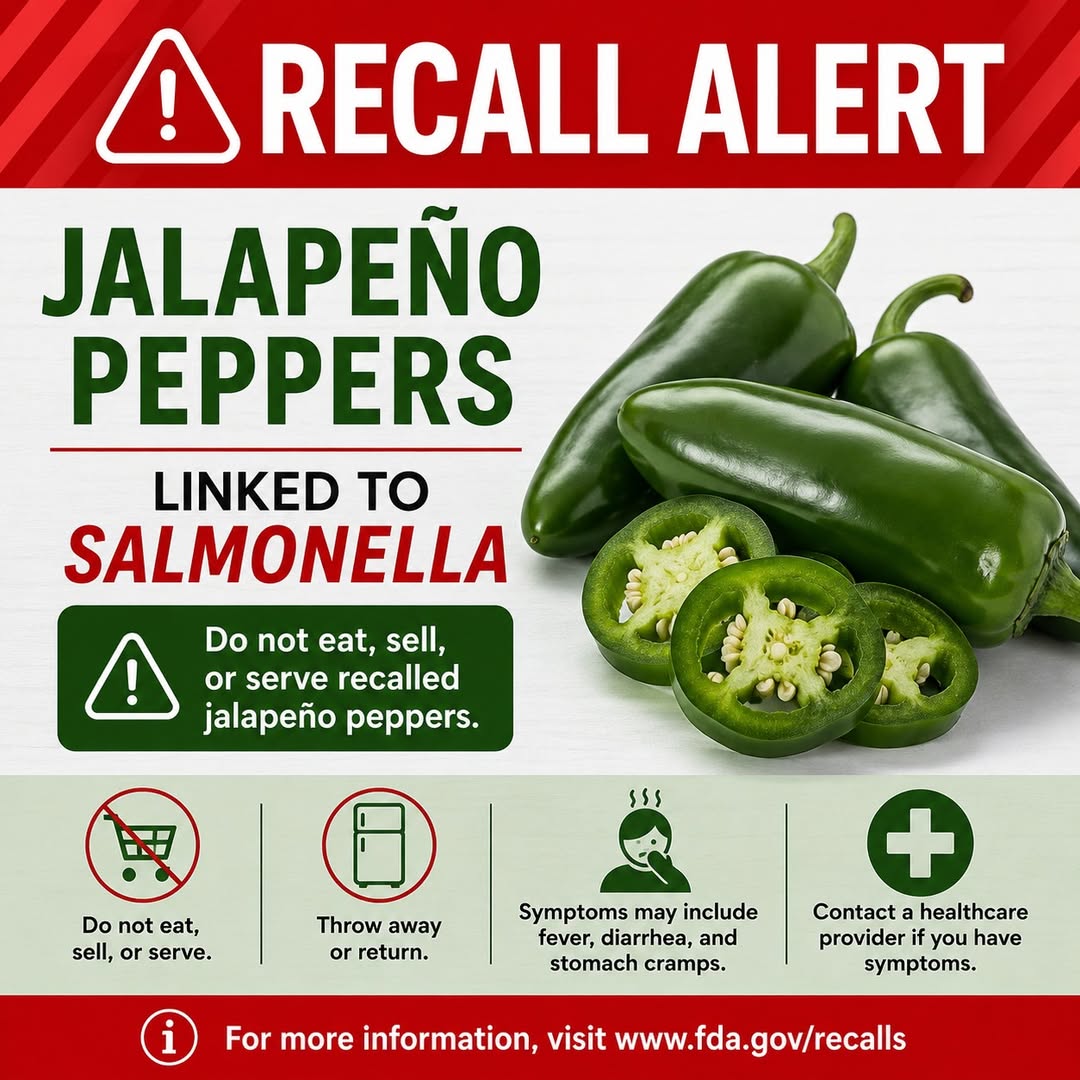

The recall does not identify New Mexico-grown jalapeños or green chile as affected products.
Source: New Mexico Environment Department, Food & Drug Administration
Images: Courtesy
The New Mexico Environment Department is alerting residents to an ongoing federal recall involving fresh jalapeño peppers grown in Sinaloa, Mexico, as the U.S. Food and Drug Administration continues investigating a Salmonella outbreak associated with the imported peppers.
The recalled jalapeños were distributed by Coast Citrus Distributors to wholesalers and restaurants, according to the FDA.
The recall does not identify New Mexico-grown jalapeños or green chile as affected products.
NMED advised consumers, restaurants and retailers not to eat, serve or sell the recalled jalapeños.

Case Count Map (Provided by CDC)
Recall Has Expanded to Prepared Foods
The investigation has grown beyond the original fresh peppers because recalled jalapeños were subsequently used as ingredients in prepared foods.
Downstream recalls have included certain salsas, guacamole, pico de gallo and other prepared products, as well as meat and poultry products addressed through a separate U.S. Department of Agriculture Food Safety and Inspection Service public health alert.
The FDA lists stores that received products containing recalled jalapeños including HEB, Kroger, Target, Trader Joe’s, Walmart and Whole Foods, among others.
However, the distribution information currently published for several of the identified downstream recalls does not list New Mexico.
NatureBest products identified in an Aug. 14 recall were distributed to retail customers in Texas and Louisiana.
A Whole Foods Market recall announced Aug. 12 covers products sold in Texas, Oklahoma, Louisiana, Arkansas, Wisconsin, Michigan, Illinois, Indiana, Iowa, Missouri, Kentucky and Ohio.
Taylor Fresh Foods recalled multiple products Aug. 9 that had been distributed across 27 states. New Mexico was not among those listed.
The FDA said Coast Citrus Distributors does not appear to supply jalapeños directly to grocery stores. Instead, affected peppers reached wholesalers, restaurants, food-service businesses and manufacturers, some of which incorporated the peppers into other products subsequently sold at retail.
The agency is continuing to determine the full distribution of the affected jalapeños.

Restaurant Products Also Identified
The FDA said Chipotle and QDOBA both received jalapeños imported by Coast Citrus Distributors from Sinaloa.
Chipotle changed suppliers for affected stores beginning July 20 and is no longer serving the affected product. QDOBA stopped using jalapeños July 28, according to the FDA.
Because of those actions, the FDA said it does not consider either restaurant chain to pose a current ongoing risk to consumers from the outbreak.
What Consumers Should Know
The FDA advises consumers, restaurants and retailers not to eat, sell or serve recalled products.
Food-service businesses with fresh jalapeños from Sinaloa imported by Coast Citrus Distributors should not sell or serve them.
Consumers who previously froze affected peppers should discard them. The FDA also recommends discarding frozen jalapeños if consumers are unsure of their supplier and cleaning and sanitizing surfaces or containers that may have come into contact with affected products.
Salmonella illness generally develops within 12 to 72 hours after consuming contaminated food and commonly causes diarrhea, fever and abdominal cramps. Symptoms typically last four to seven days.
Young children, older adults and people with weakened immune systems are at greater risk of severe infection.
The FDA investigation remains ongoing, and the agency said additional distribution information will be released as it becomes available.
You must be logged in to post a comment.