
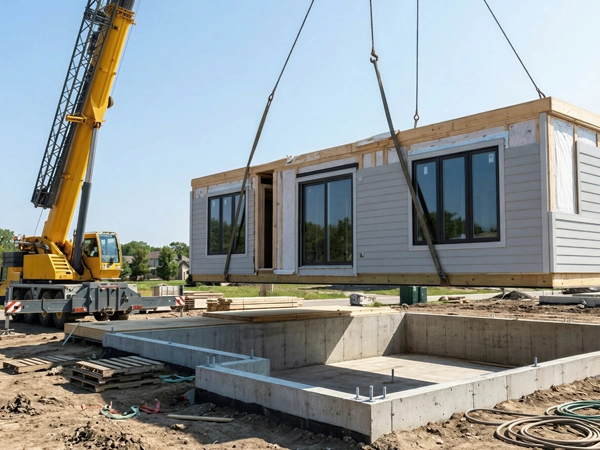

Offsite construction refers to building methods in which factories produce major parts of a home or building, which then are transported to the final site.
Source: Housing and Urban Development
Photo: Courtesy
This article is part of a series discussing the current research activities of the Affordable Housing Research and Technology Division within the Office of Policy Development and Research.
A new report, “HUD’s Past, Present, and Future Role in Accelerating U.S. Offsite Construction for Housing: A Comparative Study and Action Plan,” examines the role of offsite construction in meeting the nation’s housing needs. The March 2026 report, funded by the Office of Policy Development and Research and coauthored by the National Institute of Building Sciences and MOD X, recounts HUD’s past work in advancing industrialized housing, compares the U.S. experience with the offsite construction of housing with that of other countries, and identifies steps that could expand offsite construction in the United States.
Offsite construction refers to building methods in which factories produce major parts of a home or building, which then are transported to the final site. These methods can include panelized construction, modular construction, factory-built components, and other approaches that bring more of the building process indoors under controlled conditions.
Receive the latest stories in your inbox every day — FREE!
Importance of a supportive ecosystem
One of the report’s primary conclusions is that growth of the offsite construction sector is being hindered not by the state of technology but rather by the misalignment of supportive systems. Jurisdictions developed building codes, permitting, inspections, financing, insurance, procurement, and project delivery practices primarily around traditional site-built construction methods. Applying these systems to offsite construction without adjustment can create uncertainty, delay, and added costs.
The report contextualizes this point through a case study of Operation Breakthrough, a major HUD effort launched more than 50 years ago to test whether industrialized construction methods could help produce better housing at greater scale. The initiative brought together public sector workers, builders, manufacturers, designers, researchers, and other partners to explore new ways of producing homes. Although it did not result in a permanent national offsite construction industry, Operation Breakthrough influenced future manufactured housing regulation, industrialized building programs, and the broader idea of certifying housing systems. The report states that Operation Breakthrough demonstrated the promise of industrialized construction but did not adequately address the institutional barriers needed to support long-term market adoption. Those barriers remain important today. Based on this history, the report suggests that a successful offsite construction sector needs both advanced technology and an ecosystem that allows homes and building components to move on a predictable path through design, approval, financing, construction, inspection, and occupancy.
The report comes to a similar conclusion through a comparison of the different paths that the United States, Japan, Sweden, and the United Kingdom took to nurture their industrialized housing industries. These national case studies reveal several common lessons, one of which is that, in countries where offsite construction has reached a larger share of the housing market, governments have fostered stable environments for innovation. These governments did not stop at funding individual projects; they also aligned rules, supported consistent demand, set clear expectations, and built institutions that connect public goals with private-sector delivery.
Regulatory reform and demand aggregation
The report also emphasizes two ideas: regulatory reform and demand aggregation.
In the United States, construction regulations, rules, and review processes may vary from place to place, and jurisdictions may not always apply them in the same way. For example, industrialized building programs can differ among states, local officials may interpret building codes differently, and building code officials may accept third-party inspections or evaluations in one location but question them in another. These differences make building homes for a broad market harder for offsite manufacturers. Factory-based construction works best when companies can use repeatable designs, get predictable approvals, and keep production moving. Having to design, review, and explain the same building system in each location erodes the cost and time savings that offsite construction is meant to provide. The report introduces the concept of regulatory reform to respond to these inconsistencies. Regulatory reform means adapting rules and review processes to better fit different construction methods, including offsite construction, while still protecting safety, quality, and performance. Concluding that regulations should be consistent for site-built and offsite-built housing, the report finds that current rules often favor site-built construction.
Demand aggregation means creating a more predictable pipeline of projects. Offsite construction often requires significant upfront investments in design, equipment, quality control, workforce training, and manufacturing capacity. Manufacturers are more likely to make those investments when they can see steady demand across many projects rather than a series of one-time opportunities. The report explains that several ways exist to aggregate demand, including through public procurement of offsite construction for government-financed projects, government-coordinated procurement of offsite construction by other organizations, or consistent award criteria for federally supported housing programs.
In the four national contexts studied in the report, an interplay of regulatory reform and demand aggregation proved effective in accelerating and scaling offsite housing construction. Demand aggregation without regulatory reform may create immediate increases in construction activity, but it can leave the offsite construction industry dependent on a limited set of government programs or subsidies. Regulatory reform without steady demand may reduce barriers to the acceleration and scaling of offsite construction, but sufficient market volume may materialize too slowly to support new investment. Together, regulatory reform and demand aggregation can help offsite construction move beyond individual projects and become a more reliable part of the housing delivery system.
Action Plan
Based on the Operation Breakthrough case study and international comparisons, the report then offers an action plan with immediate, intermediate, and long-term recommendations.
The report’s immediate-term strategy centers on standardizing award criteria. When selecting builders, manufacturers, developers, and lenders for offsite construction, federal housing-related programs should use more consistent language, measures, and expectations in their award criteria. Employing consistent criteria would clarify which types of projects qualify for an award and how they will be evaluated. Doing so could also reduce confusion created when different federal programs use different labels, such as “factory built,” “prefabricated,” “modular,” or “industrialized construction,” to refer to related offsite building approaches.
By contrast, the report’s intermediate-term recommendation focuses on developing and implementing a housing system certification program for offsite housing construction. This type of program would evaluate building systems based on performance, quality control, and the ability to produce the same system consistently. Certification for offsite construction could reduce the need for repeated reviews, give regulators and lenders more confidence in approved systems, and make using proven systems across multiple projects or jurisdictions easier. The report positions housing system certification as a bridge between today’s fragmented regulatory environment and a future system that better supports innovation.
Finally, the report identifies the adoption of performance-based building codes as a long-term strategy. Prescriptive codes generally tell builders how a building must be constructed. Performance-based codes focus on required outcomes, such as a building’s structural safety, fire protection, or resilience. Performance-based codes, the report argues, can better support innovative methods, including offsite construction, because they free the builder to demonstrate that they meet safety, durability, energy, resilience, and other performance goals. Moving toward full adoption of a performance-based framework would take time, but the report suggests that it could create a more flexible housing sector that is better able to test, approve, and adopt new innovations.
Conclusion
Discussions of offsite construction often are limited to narrow considerations of greater speed and lower costs, but the report takes a broader view by positioning offsite construction as part of a larger delivery system that includes building codes, standards, housing finance, procurement, workforce, inspections, and market confidence.
The cost or structural advantages of a modular unit, panelized wall system, or factory-built component can be lost if a project faces unclear approvals, financing concerns, inconsistent inspection requirements, or poor coordination between the factory and the jobsite.
Instead of presenting offsite construction as a singular solution to housing challenges, the report suggests that offsite construction can play a larger role if public and private partners address the barriers that make it hard to scale. Many of those barriers involve rules, relationships, and market signals that shape how the industry finances, approves, produces, and delivers housing.
By examining HUD’s early industrial construction initiative, comparing international experience, and identifying a sequence of possible actions, the report offers a useful framework for continued discussion. It also reinforces a practical lesson from earlier housing innovation efforts: demonstration projects can show what is possible, but lasting progress requires integrated systems that allow the industry to repeat successful approaches.
The report envisions a housing sector in which public agencies, private industry, universities, standards organizations, and nonprofit partners work together to test, improve, and scale better ways to build houses, with an eye toward creating conditions that allow different construction methods to compete, improve, and respond to housing needs.
Published Date: 20 August 2026
The contents of this article are the views of the author(s) and do not necessarily reflect the views or policies of the U.S. Department of Housing and Urban Development or the U.S. Government.
You must be logged in to post a comment.