
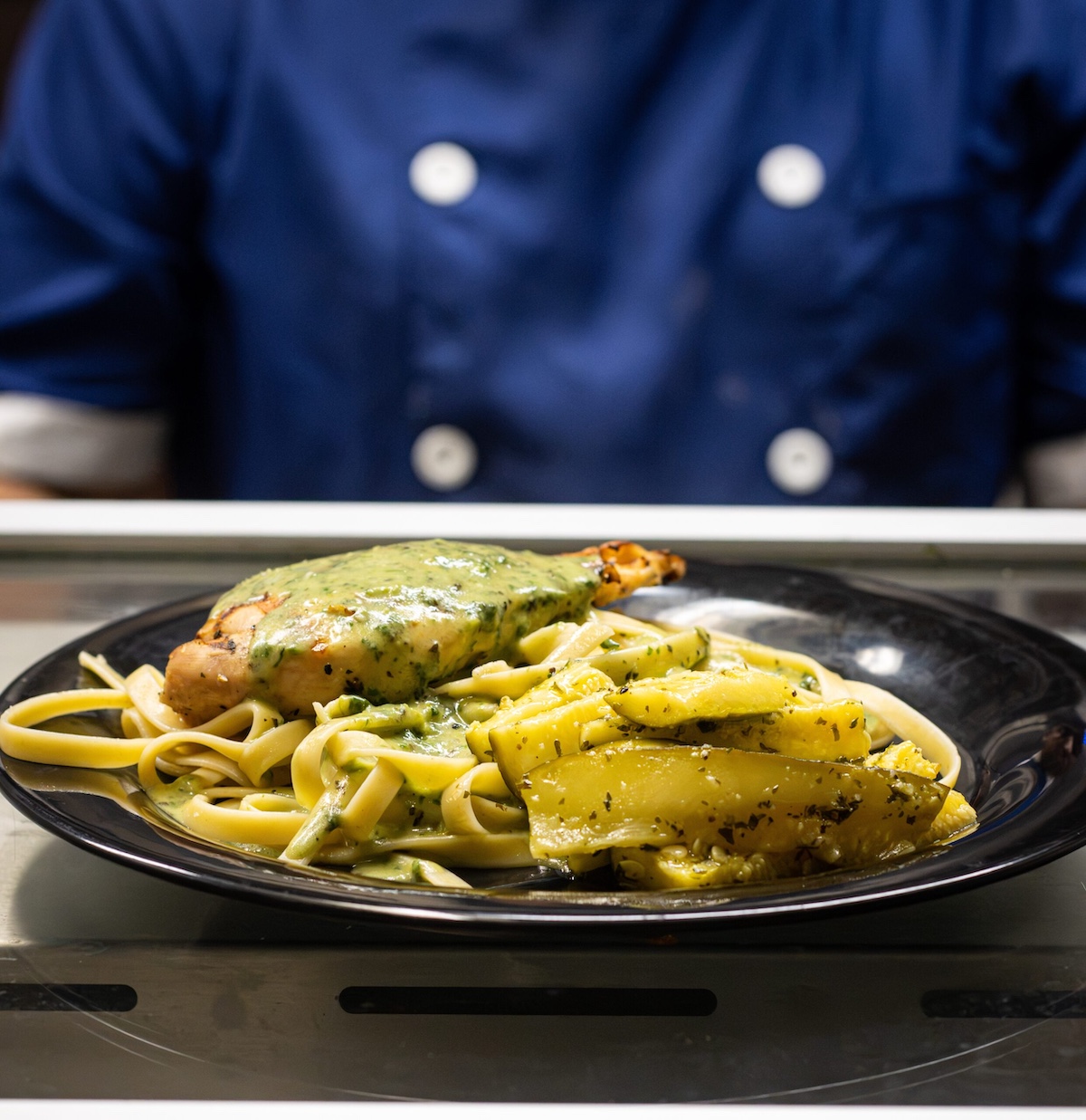

A new food-service vendor, Mario’s Catering, is providing meals at the academy as part of a broader effort to modernize and improve the training experience.
Source: New Mexico Department of Public Safety
Story by New Mexico Department of Public Safety Public Information Officer John Heil.
Photos by DPS Media Relations Unit – Curtis Althaus.
For county and city police cadets and state police recruits at the New Mexico Law Enforcement Academy, the days are long and demanding.
There is physical exertion, classroom instruction, firearms training and the constant pressure of preparing for a career in which decisions can carry enormous consequences.
Now, the New Mexico Department of Public Safety is putting more emphasis on something that happens between those exercises and lessons: what cadets/recruits eat.

Mario’s catering – from left to right: Rafael Mendez, Marcos Gonzalez and Heber Ramirez. The other member of the team not pictured is Roberto Cardenas Navarrete.
For the department’s Director of Operations Andrea Sandoval, the question was straightforward: If the academy was looking for ways to raise the quality of its training, why shouldn’t that include the food?
“We really looked at it as an opportunity to improve, and to do better for our recruits and cadets when we chose to go down this road,” said Sandoval.
The department put the food-service contract out for a request for proposals, allowing multiple vendors to compete. As part of the selection process, each vendor was asked to prepare meals for the evaluation team.


New Mexico State Police recruits enjoy their meal at the academy.
The department knew their cadets and recruits needed substantial meals. Their days involve physical exertion as well as the cognitive demands of classroom instruction, and officials wanted meals that included quality protein, carbohydrates, fruits, vegetables and the other components of a balanced diet.
One major calculation behind the investment is that hungry recruits are not going to perform at their best, said Sandoval. And meals that are nutritious but unappealing are not much help if people do not want to eat them.
“You can put a healthy meal out there, and if it doesn’t taste good, it doesn’t accomplish much because people won’t eat it,” said Sandoval.
That is why taste and presentation became important considerations alongside nutrition.
Receive the latest stories in your inbox every day — FREE!
The difference can be as simple as breakfast. Under the previous food service, recruits were served powdered eggs. Under the new vendor, they get fresh eggs.
“That’s a huge difference,” said Sandoval.
The department’s decision also represents a financial commitment. The new food service costs more than the previous arrangement, but officials decided the additional expense was worth making.
“We made a worthwhile investment,” said Sandoval. “The academy is responsible for more than putting food on a plate. It is preparing the next generation of law enforcement officers for a difficult profession.”

That preparation has been undergoing changes in other areas, too, including updates to the academy’s curriculum and training programs according to Deputy Cabinet Secretary Sylvia Serna who has overseen a number of changes for the past several months. The department sees the food-service overhaul as another piece of that larger endeavor.
“This is part of a broader effort to modernize and improve the academy training, so our cadets and recruits are fully prepared to enter their communities to handle the challenges they will face as law enforcement officers,” said Serna.
There is another potential benefit that is less tangible but still important: morale.
Training at a law enforcement academy can be stressful. A good meal does not make the work easier, but it can provide a welcome break in a demanding day.
“We’re not just feeding people,” said Sandoval. “We’re feeding the future law enforcement officers.”
The department also hopes that providing better meals can encourage healthier habits that cadets and recruits carry with them after graduation. Officials cannot know whether they will continue those habits once they leave the academy, but the opportunity is there.
Even the menu itself is becoming something of a conversation between the vendor and the people eating it. Mario’s Catering is paying attention to what recruits and cadets like and what they do not. The goal is to provide variety rather than simply repeating the same institutional meals, with the possibility of incorporating seasonal foods as well.

The operation also must accommodate the realities of academy training. When cadets/recruits are sent off-site, instructors can place meal orders so food can be ready on time. The department says communication between the academy and the vendor has helped make the process relatively seamless.
According to Sandoval, the larger point is not whether food alone can make a better police officer. It is that every part of the academy experience should contribute to preparing cadets and recruits for the job ahead.
The food-service change began with a kitchen remodel and a procurement process. It ended with a decision to spend more money on something that might once have been viewed as little more than a basic necessity.
“We wanted to give them not only the best training that we could in the classroom but overall,” said Sandoval. “This was one of the opportunities to improve and to do better for our cadets and recruits.”
You must be logged in to post a comment.